Riprap is a sloped layer of heavy rock placed at the base of a bulkhead or an eroding bank to absorb waves and current. On Hilton Head, it's allowed on creeks and sound-side banks that meet South Carolina's critical area rules, but not as new armor on the ocean beach.
✓ Hilton Head Experts✓ Licensed in GA & SC✓ Free Inspections✓ 30 Years Experience
Quick Answer
Seawall Repairs by Solid Foundations provides riprap installation in Hilton Head Island, SC for homeowners, property owners' associations, and commercial waterfronts. Typical projects include toe protection for bulkheads facing boat traffic on Broad Creek, rock for eroding banks along Skull Creek, and riprap installed alongside new walls. Call 866-398-9323 or use the quote form to book a free on-site inspection.
Where Is Riprap Allowed on Hilton Head?
It depends on which side of the island you're on.
Oceanfront: South Carolina doesn't allow new erosion control structures on the beach or in the beach/dune system. Existing grandfathered structures can be maintained but not enlarged or strengthened (SCDES beachfront FAQ). The Town handles beach erosion with renourishment. Its 2025–26 project was designed to place about 2.2 million cubic yards of sand along roughly 46,500 feet of shoreline and included six rock breakwaters at Pine Island (Town of Hilton Head Island).
Creeks and sound-side banks: Riprap is regulated as a revetment under SC Regulation 30-12. It must follow the critical area line, can sit up to 18 inches from the escarpment, and isn't allowed where marsh is already buffering erosion, unless upland is being lost to the tide.
We confirm which rules apply before pricing. If a new wall is coming, permitting both together is simpler. See bulkhead replacement on Hilton Head.
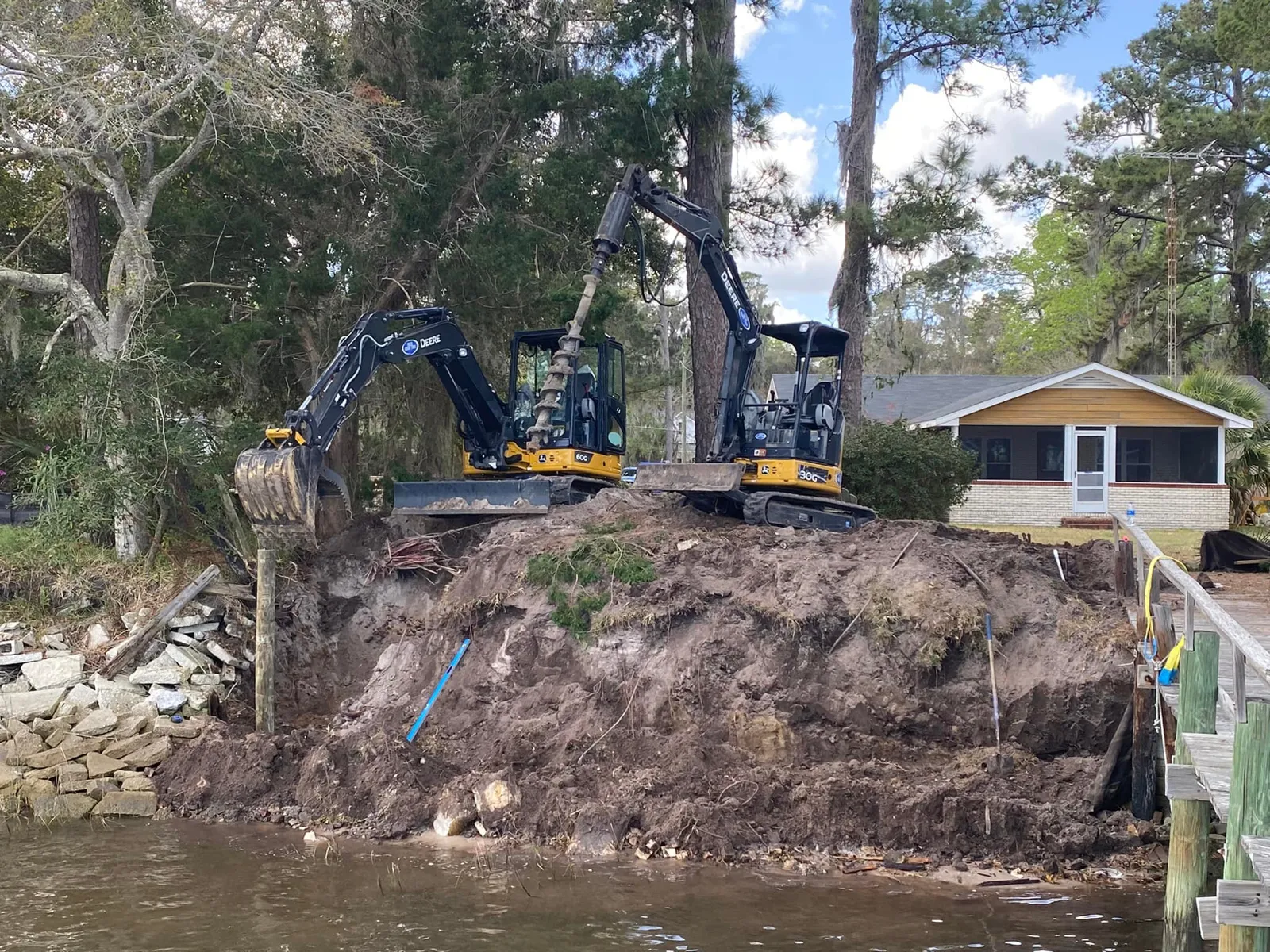
Our crew restoring an eroded bank along the water.
What Does Riprap Do for a Wall or Bank?
Waves and wake that hit a vertical wall bounce downward and dig out the base, a process called scour. An undercut toe leads to a leaning wall. Riprap:
Absorbs energy before it reaches the wall
Covers the toe so it can't be dug out
Slows current along the bank
Gives oysters and small creatures somewhere to live
On Hilton Head, boat traffic adds to the load. Broad Creek is home to Shelter Cove, the island's largest deep-water marina, and steady wake on a busy creek works at the base of every wall along it.
How Do We Install Riprap on the Island?
Survey at low tide: depth, scour, escarpment, and critical line
Prepare the base so stone doesn't sink into soft mud
Lay filter fabric to keep soil from washing out
Place stone to the approved slope and footprint
Final check against permit conditions
Some jobs are best done from the water to protect lawns, trees, and irrigation. Inside gated communities, we also coordinate delivery routes and staging so trucks and equipment don't block shared roads or damage common areas.
Is a Living Shoreline Worth Considering?
On quieter creeks, it can be. South Carolina encourages living shorelines in estuaries as an alternative to hard structures. They must stay within your extended property lines and generally can't go in creeks under 20 feet wide. On a high-wake reach of Broad Creek, rock usually makes more sense. We'll recommend what fits your bank.
How Much Does Riprap Cost on Hilton Head?
Riprap installation in Hilton Head typically costs $125–$350 per linear foot. A standard 75-foot residential installation runs $10,000–$25,000, fully installed and permitted. Stone volume, base prep, and access affect the price.
Can I put rock in front of my beachfront home on Hilton Head?
No. New erosion control structures aren't allowed on South Carolina beaches. The Town addresses beach erosion through renourishment.
Does boat wake on Broad Creek justify riprap?
Often, yes. Steady wake scours the base of a wall, and rock at the toe absorbs that energy.
Why were rock breakwaters used at Pine Island if seawalls are banned on the beach?
They were part of the Town's permitted renourishment project, not a private seawall. Private owners can't add new erosion control structures to the beach.
Will riprap get in the way of my dock?
It extends a few feet from the wall. We shape it around pilings and floats so boat access stays clear.