A Hilton Head bulkhead that has started to lean but still has sound sheeting can usually be stabilized with helical tiebacks for much less than a rebuild.
✓ Hilton Head Experts✓ Licensed in GA & SC✓ Free Inspections✓ 30 Years Experience
Quick Answer
Seawall Repairs by Solid Foundations provides seawall reinforcement in Hilton Head Island, SC for homeowners, property owners' associations, and commercial properties. Typical projects include helical tiebacks on Broad Creek walls that shifted after Hurricane Matthew, walers on long lagoon bulkheads, and replacing rusted tie rods on older marsh-front walls. Call 866-398-9323 or use the quote form to book a free on-site inspection.
When Should You Reinforce Instead of Replace?
Reinforcement makes sense when the wall is moving but intact:
The cap leans toward the water.
The wall bows out mid-span.
Cracks open between the cap and your lawn or patio.
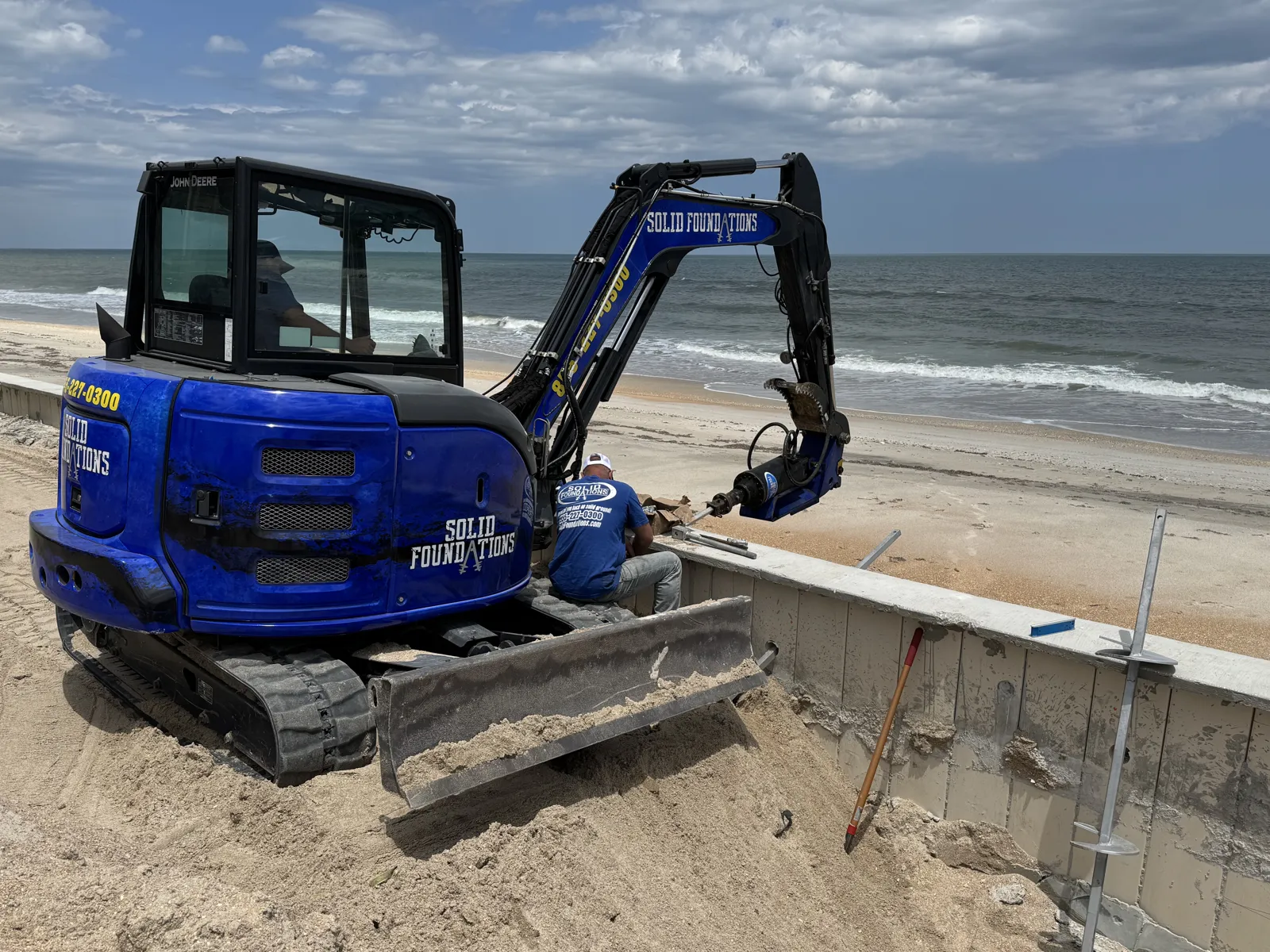
Helical tiebacks going in on a beachfront seawall.
What Pushes Hilton Head Walls Over?
Storm water piled up behind them. When Hurricane Matthew passed in October 2016, its eye came within about 20 miles of the island, and gusts reached 87 mph. Roads went under water, and about ten sailboats ended up ashore at Palmetto Bay Marina (CBS News). High water like that saturates the fill behind a wall. As it drains, the heavy soil leans on the structure.
Big daily tides. Broad Creek averages close to 7.5 feet between high and low water. The fill behind a creek wall is always wet, so the load never fully lets up.
Rusting anchors. Older bulkheads often depend on steel tie rods. After decades in salt water, many are too thin to hold.
Which Reinforcement Methods Do We Use?
Helical tiebacks
We drill steel anchors with helical plates through the wall at an angle into firm soil, then lock them off at the face. Each one works like a new tie rod, and most homes are done in one to two days. More on helical tiebacks.
Deadman anchors
Where the lot has room, a buried concrete block tied to the wall with rods can carry the load.
Walers
A continuous beam along the face spreads anchor loads evenly, which helps on long lagoon or creek runs.
Voids and drainage
Pairing anchors with polyurethane void fill and relief drains keeps the soil solid and the pressure down.
Is Reinforcement Cheaper Than a New Wall?
Reinforcement
Replacement
Typical 80-ft residential wall
$12,000–$35,000
$40,000–$80,000
Time on site
Usually 1–3 days
Usually 1–3 weeks
Landscaping disruption
Light
Heavy
Approvals
Usually simpler
Engineering plus state, federal, and community review
For a lot of island owners, anchoring is a bridge. It holds the wall steady for years while you save for, plan, and permit an eventual replacement. We'll give you an honest read on how much life the sheeting has left, so you're budgeting against a real number instead of a guess.
What a typical reinforcement day looks like
We mark utilities and irrigation, set up on the lawn side, and drill each anchor in sequence along the wall. After torque readings confirm each one, we tension it and fit the face plates or waler. Cleanup is usually a matter of re-setting a few pavers or patching small areas of sod. Most owners are surprised how little of the yard is disturbed.
Why Test the Soil Before Setting Anchors?
The island's creek and marsh edges often shift from sandy upland soil to soft pluff mud within a short distance. Anchors set in soft ground won't hold much. We drive tiebacks through to firmer soil and log torque on each one to verify capacity. If decks or docks near the wall are settling, see marine foundation repair on Hilton Head. For our full local service list, visit Hilton Head seawall repair.