If your Savannah seawall or bulkhead is tilting but the sheeting is still intact, new anchors can stop it moving for a fraction of what a full rebuild costs.
✓ Savannah Experts✓ Licensed in GA & SC✓ Free Inspections✓ 30 Years Experience
Quick Answer
Seawall Repairs by Solid Foundations provides seawall reinforcement in Savannah, GA for homeowners, HOAs, and waterfront businesses. Typical projects include helical tiebacks on bulkheads that shifted after Matthew's record storm tide, new walers on long Isle of Hope runs, and replacing corroded tie rods on older creek walls. Call 866-398-9323 or use the quote form to book a free on-site inspection.
When Is Reinforcement the Right Fix?
Anchoring works best when the wall itself is in decent shape but it's starting to move:
The cap line leans toward the water.
A belly is forming midway along the run.
New gaps appear between the cap and the lawn or deck.
The wall shifted in a storm but nothing broke.
Old tie rods are rusted or no longer tight.
When the sheeting has split or the toe has blown out, anchors alone won't save it. Look at bulkhead replacement in Savannah instead.
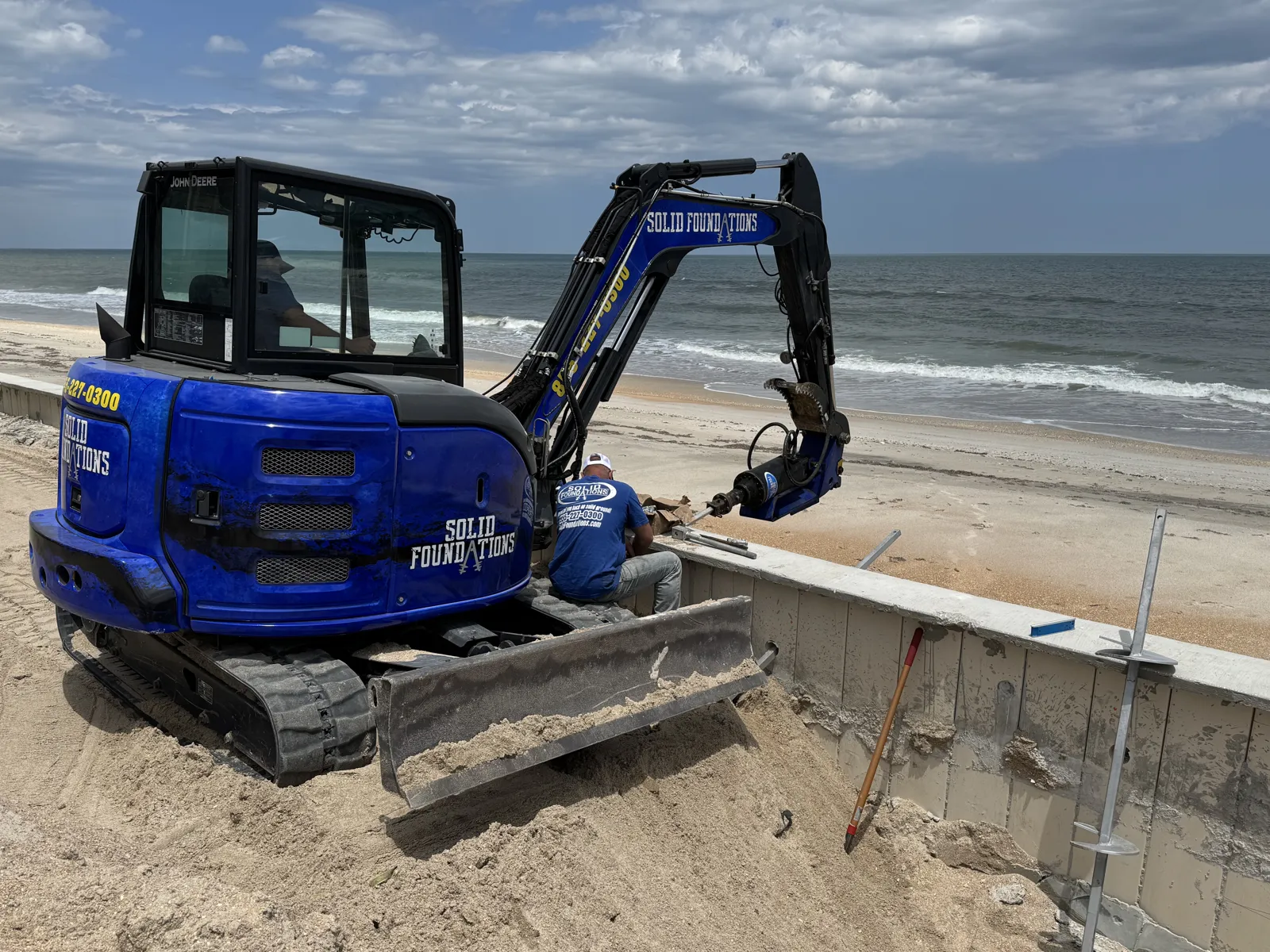
Helical tiebacks going in on a beachfront seawall.
What Makes Savannah Walls Lean?
Record storm tides. When Hurricane Matthew passed in October 2016, the Fort Pulaski gauge logged a storm tide of 12.56 feet above mean lower low water, the highest on record there, with about 7.7 feet of surge (National Weather Service). Less than a year later, Irma pushed the same gauge to 12.24 feet. Water that high soaks the fill behind a wall; when it drains, that heavy, wet soil shoves outward.
The daily tide cycle. Even in fair weather, roughly seven feet of water rises and falls against your wall. The soil behind it never fully dries, so the load on the anchors never lets up.
Worn-out hardware. Many older bulkheads in Chatham County lean on steel tie rods tied to buried anchors. Salt water eats those rods over the years, and a wall that loses its anchors starts to rotate.
How Do We Reinforce a Savannah Seawall?
Helical tiebacks
We drill steel anchors with screw-shaped plates through the wall at an angle and into firm soil behind it, then lock them off at the face. Each one works as a new tie rod. On most homes, the work takes a day or two with little disturbance to the yard. Learn more about helical tiebacks.
Deadman anchors
On lots with room behind the wall, a buried concrete block tied back with rods can carry the load.
Walers
A continuous beam along the face spreads each anchor's pull across the whole run, which helps on long walls.
Fixing the soil and water too
Anchors last longer when the ground behind the wall is solid and water can escape. We often pair them with void fill and relief drains.
Does Reinforcement Save Money Over Replacement?
Reinforce
Replace
Typical 80-ft residential wall
$12,000–$35,000
$40,000–$80,000
Time on site
Usually 1–3 days
Usually 1–3 weeks
Disturbance to yard and dock
Light
Heavy
Approvals
Usually simpler
Engineering plus state and federal review
Plenty of owners reinforce now and budget for a new wall years later. That's a sound plan when the sheeting has life left in it. Start with a free look through our Savannah seawall repair team.
Why Do Anchors Need Extra Depth Near the Marsh?
Coastal Georgia holds about a third of all salt marsh on the East Coast, and the mud under it is saturated and low in oxygen (UGA Marine Extension). That soft layer can't hold an anchor well. We drive tiebacks past it into firmer ground and track the torque as each one goes in, so we know it will carry the load. If a deck or dock near the wall is also sinking, see marine foundation repair in Savannah.
My bulkhead has been tilting since Hurricane Matthew. Can it still be anchored?
Often, yes. If the sheeting is intact, tiebacks can usually stop further movement. Some walls can even be drawn partway back. Waiting tends to shrink your options.
Will drilling tiebacks damage my oak trees or irrigation?
The anchors go in at an angle below grade, and we locate roots, lines, and utilities first so we can route around them.
Does anchoring a wall on a tidal creek need Georgia approval?
Work on marsh and shore structures generally involves the Coastal Resources Division, and we check before starting. Anchoring from the land side is usually simpler to approve than building new wall.
How long will a reinforced Savannah seawall last?
The anchors are a permanent upgrade. How long the whole wall lasts still depends on the condition of the sheeting, and we'll be honest about that.