A Savannah bulkhead that still stands plumb can usually be repaired where it is, by refilling lost soil, sealing the gaps, and relieving water pressure, instead of being torn out.
✓ Savannah Experts✓ Licensed in GA & SC✓ Free Inspections✓ 30 Years Experience
Quick Answer
Seawall Repairs by Solid Foundations provides bulkhead repair in Savannah, GA for marsh-front homeowners, neighborhood associations, and waterfront businesses. Typical projects include sealing washouts behind bulkheads on the Skidaway River at Isle of Hope, fixing sinkholes behind creek walls on Wilmington Island, and adding relief drains to walls that stay soaked between tides. Call 866-398-9323 or use the quote form to book a free on-site inspection.
Is My Savannah Bulkhead Worth Repairing?
In most cases it is, provided the wall hasn't rotated outward and the sheeting or panels are still solid. The question we answer on every visit is where the trouble lives: on the face of the wall, in the fill behind it, or in the structure itself.
The best time to look is at dead low water, when the whole face is exposed. Check for:
Holes or dips in the yard a few steps back from the cap
A muddy stain spreading into the creek as the tide falls
Gaps between boards or panels, especially where you can see light
Split, rotten, or bored timber at the waterline on wood walls
Loose or missing hardware on walers and tie rods
Separation between the cap and your dock ramp, deck, or steps
A couple of these on a wall that still stands true is repair work. If it has kicked out at the bottom or tipped at the top, jump to bulkhead replacement in Savannah.
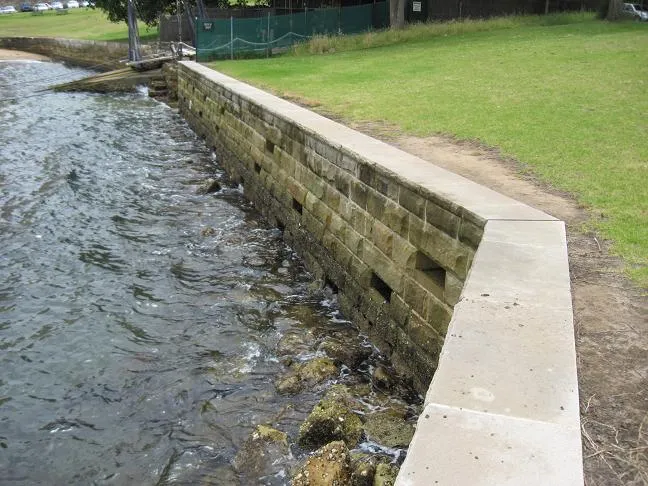
A concrete seawall and cap after repair work by our crew.
Why Do Bulkheads Fail Faster Around Savannah?
The tide is the big reason. At the Fort Pulaski gauge near the mouth of the Savannah River, NOAA puts the mean tidal range at about 6.9 feet, and the average daily swing between higher high and lower low water at about 7.5 feet (NOAA datums, Fort Pulaski). Twice a day, that much water rises against your wall and then drains away.
On the way up, water pushes into any open joint. On the way down, it pulls back out, carrying soil with it. Within a few years, a pinhole leak becomes a wheelbarrow-sized hollow. Add a soft marsh-edge subgrade and a wall that may be decades old, and you can see why washouts are the most common call we get here.
How Do We Repair Bulkheads in Savannah?
Filling the voids with polyurethane
We drill small ports along the cap and pump NCFI marine-grade foam into the hollows. It expands to fill the gaps, binds loose soil, and seals the joints from the back side, with no trench across your lawn. See how polyurethane injection works.
Sealing and patching
Open seams get sealed. Damaged cap sections are cut out, and new concrete is formed in place. On timber walls, we replace failed boards and hardware where the rest of the wall is sound.
Letting trapped water out
When water can't drain fast enough after a big tide or a summer storm, it presses on the wall from behind. Relief drains give it a way out.
We'll tell you plainly which row you're in, and we won't push a new wall when a repair will hold.
Does a Bulkhead Repair Need State Approval in Georgia?
Often, yes. The Georgia DNR Coastal Resources Division asks owners to call before starting any maintenance on an existing structure along the marsh or shore (CRD permit FAQ). Work below the high tide line or inside the marsh jurisdiction line also needs written sign-off from DNR and the Army Corps. We sort out which approvals your repair needs and handle the paperwork, whether you're inside Savannah city limits or in unincorporated Chatham County.
How Much Does Bulkhead Repair Cost in Savannah?
Bulkhead repair in Savannah typically costs $80–$250 per linear foot for void fill and $800–$2,500 per tieback anchor. Most residential repairs run $4,000–$20,000. A new wall typically costs several times that, so it pays to fix a leak early. For everything else we do locally, see seawall repair in Savannah.
Why does my yard behind the bulkhead on Isle of Hope keep sinking after big tides?
Soil is leaking out through an open seam or a hole near the bottom of the wall. The larger the tide, the more water moves through the gap. Filling the void and sealing the seam stops it.
Can you fix an old wooden bulkhead, or does it all have to go?
If most of the timber is sound, we can replace the failed boards and hardware and fill the washouts behind it. If rot runs the full length, replacement is the better spend.
Do I need to call Georgia DNR before patching my bulkhead?
The Coastal Resources Division asks owners to contact it before maintenance on existing marsh and shore structures. We make that call as part of the job.
How long does a typical Savannah bulkhead repair take on site?
Most injection and sealing jobs take one to three days once approvals are in place. We schedule around the tide so the base of the wall is exposed.