Riprap is a sloped blanket of heavy rock placed at the foot of a bulkhead or an eroding bank to take the force of waves and current. In Georgia, putting riprap on any tidal creek or river bank requires a state permit.
✓ Savannah Experts✓ Licensed in GA & SC✓ Free Inspections✓ 30 Years Experience
Quick Answer
Seawall Repairs by Solid Foundations provides riprap installation in Savannah, GA for waterfront homeowners, HOAs, and commercial properties. Typical projects include rock toe protection for bulkheads scoured by current on the Wilmington River, armoring eroding banks along the Skidaway Narrows, and pairing riprap with a new wall so the whole job is permitted once. Call 866-398-9323 or use the quote form to book a free on-site inspection.
Do I Need a Permit for Riprap in Savannah?
Yes, in nearly every case on tidal water. The Georgia DNR Coastal Resources Division states plainly that a permit is needed to put a bulkhead or riprap on any tidally influenced creek or river bank (CRD permit FAQ). Rock placed below the high tide line or inside the marsh jurisdiction line also needs written approval from the U.S. Army Corps of Engineers. On top of that, your county or Georgia EPD may review disturbance inside the 25-foot erosion and sediment buffer.
What that means for you:
Plan ahead. Some approvals ask for requests at least 45 business days before work starts.
Get the marsh line marked. State jurisdiction depends on where it falls on your lot.
Bundle the work. If a bulkhead replacement is coming, permitting both together saves time. See bulkhead replacement in Savannah.
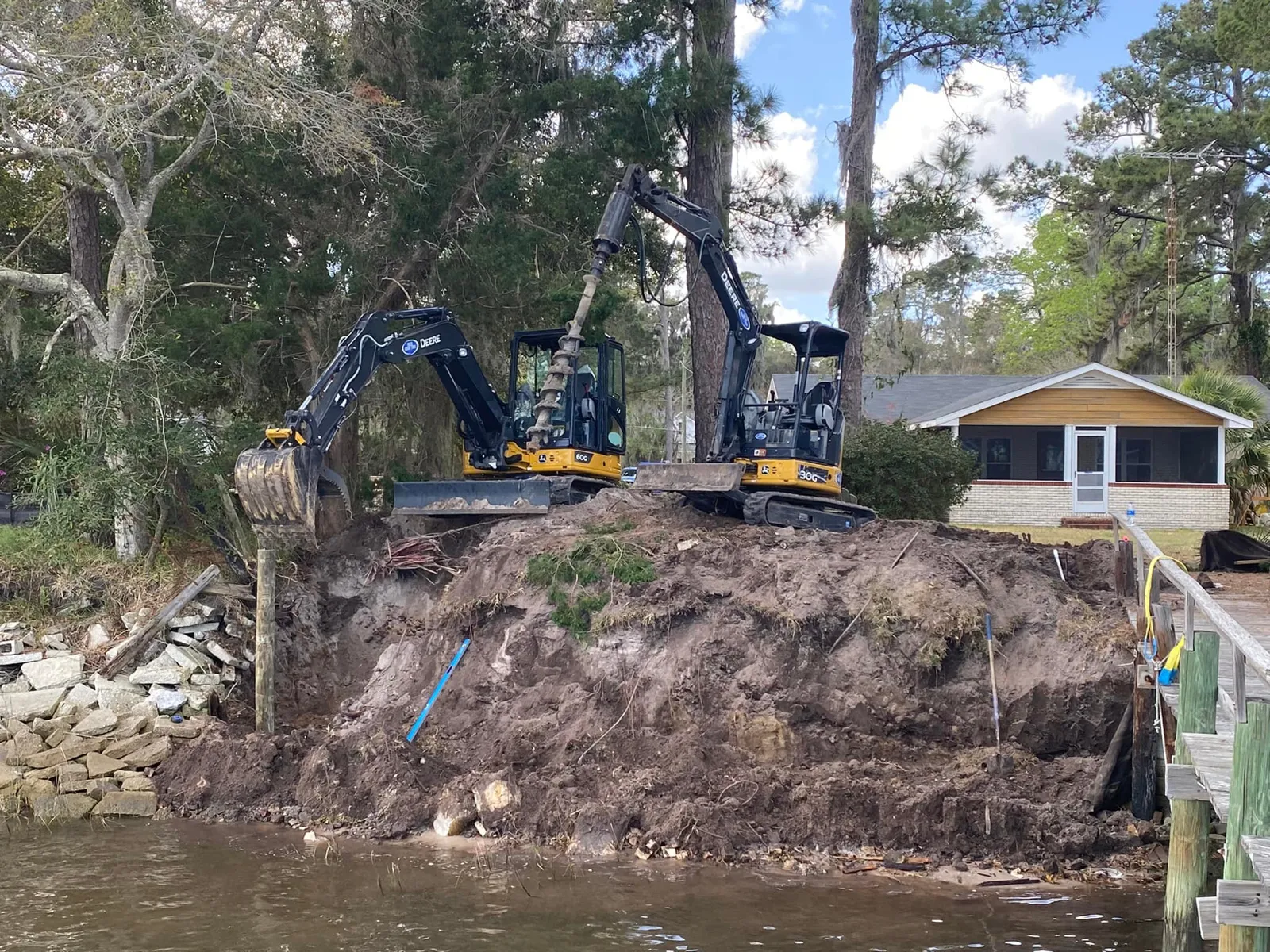
Our crew restoring an eroded bank along the water.
What Does Riprap Do for a Bulkhead?
A vertical wall bounces waves and boat wake straight back down, and that energy digs a trench at the base. We call it scour. Once the toe is undercut, the wall starts to tip. Riprap:
Soaks up energy before it reaches the wall
Shields the toe from scour
Slows current along the face of the bank
Gives oysters, crabs, and small fish places to settle in the gaps
Around Savannah, current matters as much as waves. With a mean tidal range near seven feet at Fort Pulaski, a lot of water has to move in and out of every creek twice a day. On outside bends and narrow reaches, that flow scours the base of a wall even on calm days.
How Is Riprap Installed Around Savannah?
Assess the toe. We check depth, scour, and the wall or bank condition at low water.
Mark the lines. We work from the surveyed marsh and high tide lines so the rock stays within the approved footprint.
Lay filter fabric. Geotextile keeps the soil underneath from washing out through the stone.
Place the rock. Stone size and slope come from the design and permit, sized for your exposure.
Check the finished slope. We confirm coverage, grade, and permit conditions before leaving.
Much of the work gets scheduled around low tide so the crew can see and build the toe properly.
Is a Living Shoreline an Option Instead?
Sometimes. The Coastal Resources Division recommends living shorelines, built mostly from native materials, as a long-lasting way to curb erosion in low- to medium-energy settings (CRD living shorelines). On a quiet back creek, that can be a better fit than hard rock. On a busy channel with strong current, riprap usually earns its place. We'll tell you which one your bank calls for.
How Much Does Riprap Cost in Savannah?
Riprap installation in Savannah typically costs $125–$350 per linear foot. A standard 75-foot residential installation runs $10,000–$25,000, fully installed and permitted. Stone volume, access, and water depth drive the price. More on local wall work at seawall repair in Savannah.