A rock revetment around Savannah should be inspected at least once a year and after every big storm tide, so stones that have rolled and fabric that has torn get fixed before the bank behind them starts to wash out.
✓ Savannah Experts✓ Licensed in GA & SC✓ Free Inspections✓ 30 Years Experience
Quick Answer
Seawall Repairs by Solid Foundations provides revetment maintenance in Savannah, GA for homeowners, HOAs, marinas, and commercial waterfronts. Typical projects include resetting armor stone knocked loose by storm tides, rebuilding scoured toes on tidal-creek revetments, and repairing slumped slopes where the soil underneath has washed out. Call 866-398-9323 or use the quote form to book a free on-site inspection.
What Is a Revetment, and Why Does It Need Care?
A revetment is a sloped rock bank: large armor stone laid over smaller rock and filter fabric, built to absorb waves instead of throwing them back like a vertical wall. It's durable, but it isn't set-and-forget. Storm tides, boat wake, and strong ebb currents nudge stones out of their interlock a little at a time.
In Georgia, rock revetments on beaches and shore areas fall under the Shore Protection Act, while bank stabilization in the marshes falls under the Coastal Marshlands Protection Act (GA DNR Coastal Resources Division). Either way, the Division asks owners to call before maintenance work begins.
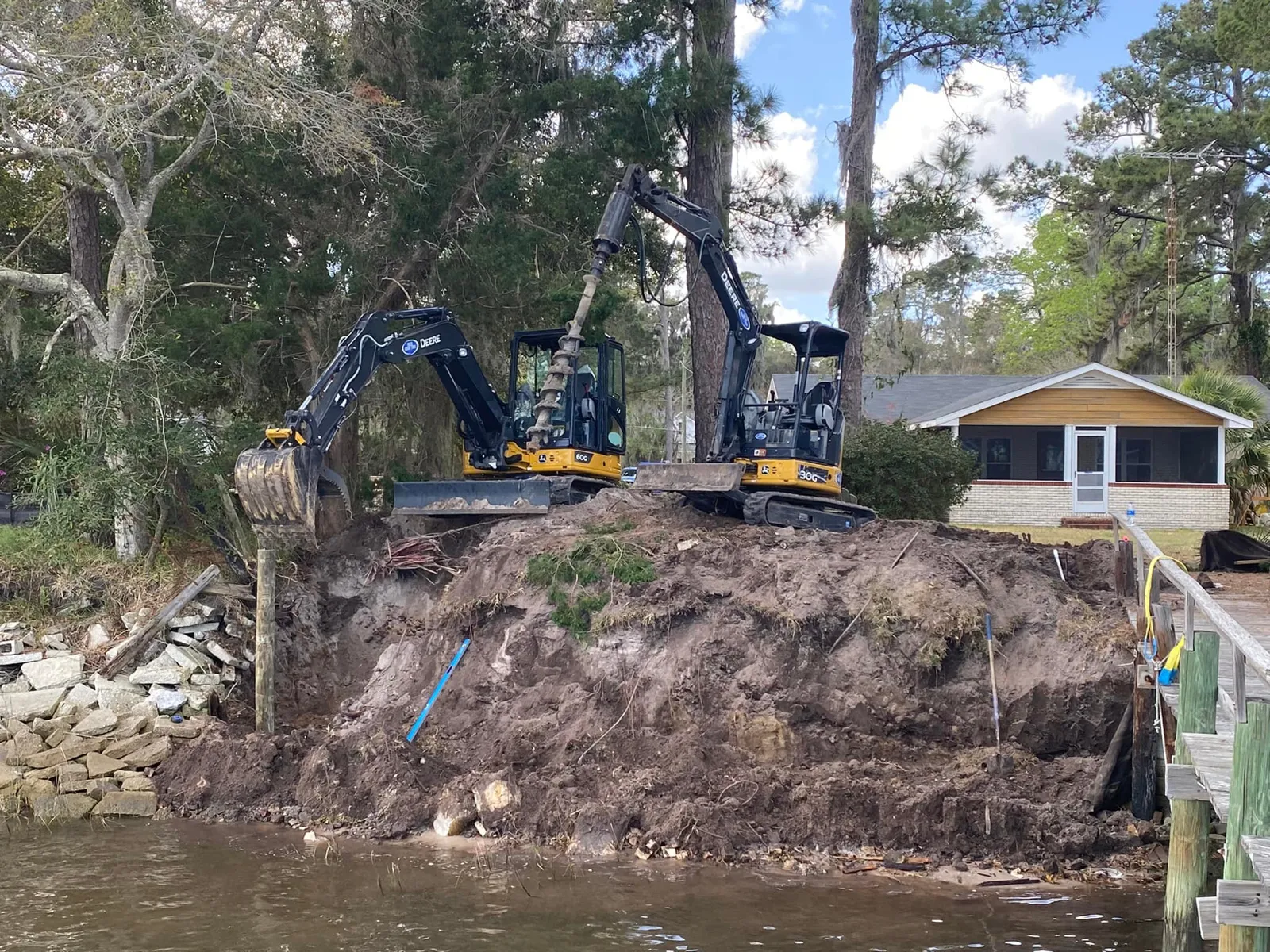
Our crew restoring an eroded bank along the water.
What Signs Mean My Revetment Needs Work?
Stones have rolled down the slope or into the creek
Sagging sections where the slope has flattened
Filter fabric showing through the rock, or torn and loose
Soil or sand washing out between stones at high water
An undercut toe at the bottom row
Erosion at the ends, where rock meets a bulkhead or a natural bank
Ends and edges usually go first because moving water curls around them.
When Should I Inspect My Savannah Revetment?
When
What to look for
Spring, before hurricane season
Full walk-down; reset loose stones; check fabric
After any named storm or storm tide
Displaced armor, toe scour, end washouts
After the year's highest tides
Soil loss at the upper edge of the rock
Once a year at a very low tide
Toe condition, slope profile, transitions
Timing a visit for a very low tide matters here more than in most places. With a mean range near seven feet at Fort Pulaski, the toe is underwater much of the day, and a low tide is the only time we can see it.
What Does Revetment Maintenance Include?
Routine upkeep
Setting displaced armor stone back into place
Adding stone where the slope has thinned
Clearing debris and marsh wrack that traps water
Rehabilitation
Toe rebuilds so the slope doesn't slide
Fabric replacement under lifted stone
Regrading slumped sections back to a stable slope
Tying in the ends to adjacent walls so water can't work behind them
Why Do Savannah Revetments Get Hit So Hard?
Two things set the area apart. First, the storm record. Hurricane Matthew sent the Fort Pulaski gauge to 12.56 feet, its highest on record, and Irma pushed it to 12.24 feet the following September (NWS on Irma). At those levels, water tops the rock and pulls at the upper slope, where the stones are often smallest.
Second, the water keeps getting higher. NOAA's Fort Pulaski gauge shows relative sea level rising about 1.4 inches per decade since 1935. Every inch puts more of your revetment in the wave zone more often. A slope that was sized decades ago may now take waves higher up than it was built for, so we look at the upper edge as carefully as the toe.
How Much Does Revetment Maintenance Cost in Savannah?
Routine revetment maintenance in Savannah typically runs $1,500–$5,000 per year for a standard 100-foot residential revetment. Major rehabilitation runs $150–$400 per linear foot. Steady upkeep usually costs far less than a rebuild after years of neglect. For wall problems behind the rock, see Savannah seawall repair.
At least once a year, ideally in spring, plus after any storm that brings unusually high water.
Why can't I see the bottom of my rock bank most of the day?
With tides this large, the toe is underwater except near low tide. We schedule inspections for very low water so we can check it properly.
Does resetting rock on my revetment need Georgia approval?
The Coastal Resources Division asks owners to contact it before maintenance on marsh and shore structures. Keeping the existing footprint is usually simpler than expanding it.
My revetment is washing out where it meets my neighbor's bulkhead. Why?
Water curls around the end of the rock and digs behind it. The fix is a proper tie-in at the transition, not just more stone.