A rock revetment on St. Simons Island should be inspected every year and after every major storm, and repairs should stay inside its permitted footprint to keep state review simple.
✓ St. Simons Island Experts✓ Licensed in GA & SC✓ Free Inspections✓ 30 Years Experience
Quick Answer
Seawall Repairs by Solid Foundations provides revetment maintenance in St. Simons Island, GA for homeowners, HOAs, condo associations, and commercial properties. Typical projects include resetting stone displaced by surge, rebuilding undercut toes along river and sound frontage, replacing exposed filter fabric, and closing washouts at the ends of rock slopes. Call 866-398-9323 or use the quote form to book a free on-site inspection.
What Is a Revetment?
A revetment is a rock slope that serves as the shoreline. Large armor stone sits on smaller stone and filter fabric, and the slope absorbs waves instead of reflecting them. Georgia's Shore Protection Act favors this kind of low-sloping porous rock where stabilization is needed on beaches, so revetments are a big part of the island's protected frontage. They're tough, but storms and tides wear them down stone by stone.
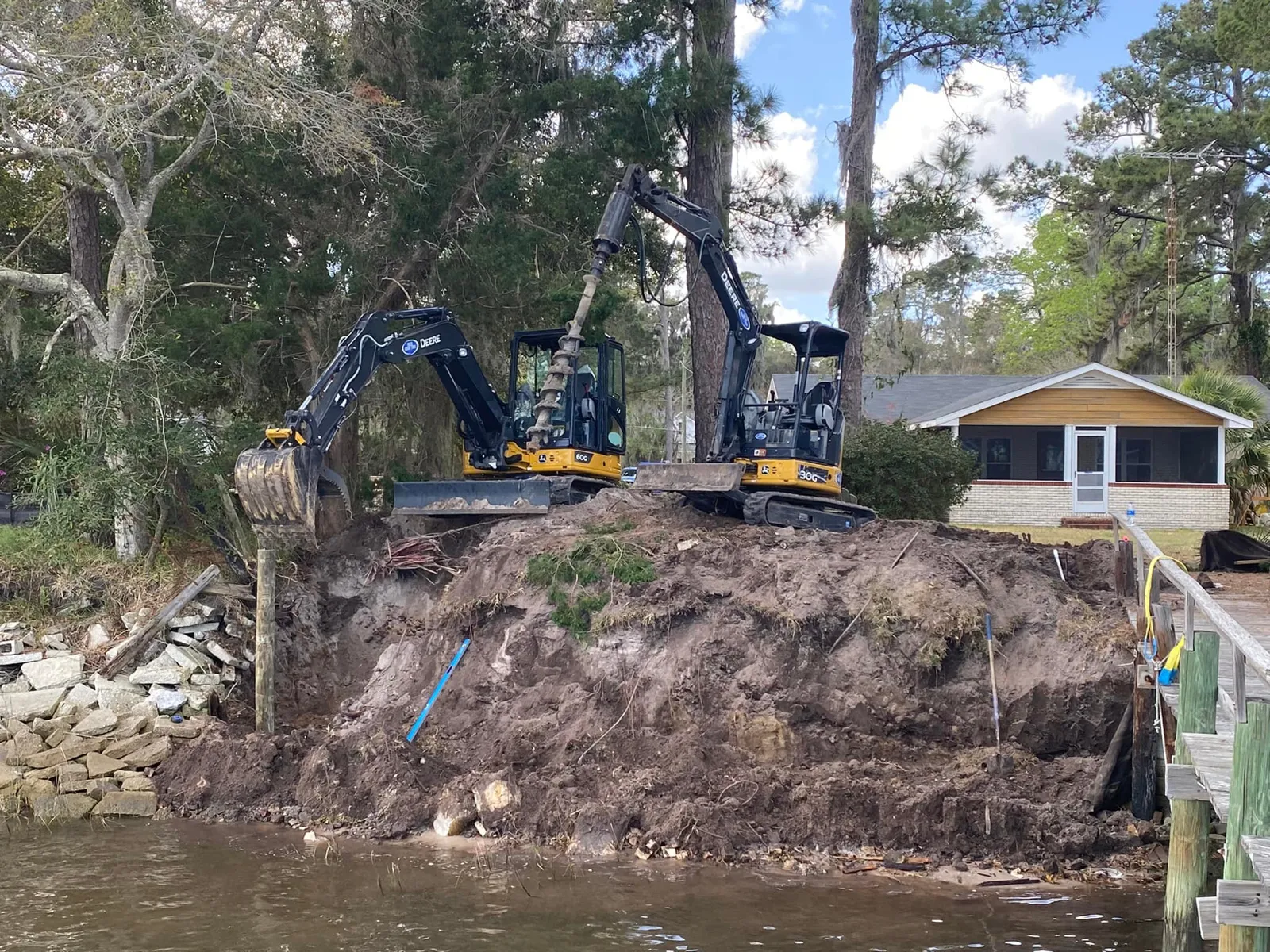
Our crew restoring an eroded bank along the water.
What Signs Mean It Needs Work?
Stones rolled off the crest or down the slope
Low spots where the slope has slumped
Filter fabric showing through
Sand or soil leaking between stones
Undercutting at the bottom row
Scour at the ends where rock meets a wall, dune or marsh bank
When Should I Inspect My Revetment?
When
What to look for
Late spring, before hurricane season
Full low-tide walk; reset loose stone; patch fabric
After a nor'easter
Moved armor stone, fresh scour at the toe
After any hurricane or tropical storm
Crest damage, end washouts, fabric exposure
After the year's biggest spring tides
Washout along the highest water line
Once a year
Slope profile and transitions
Why Do Island Revetments Take Such a Beating?
Two things stack up here. First is the tide. NOAA's St. Simons Light station shows about 7.2 feet between mean higher high water and mean lower low water (NOAA), and CRD says tides top 10 feet on spring tides. The water climbs and falls across almost the whole slope every cycle, so no part of it gets a rest.
Second is storm history. Matthew pushed water 6.2 feet above mean high tide at St. Simons Pier in 2016. Irma beat it at 6.9 feet in 2017, and a nor'easter held water high for two tidal cycles. Surge on top of high tide sends waves over the crest, where stones are often smaller and less locked in. Revetments that looked fine after one storm may have been loosened for the next.
Does Maintenance Need a Permit?
It depends where the revetment sits and what we're doing. Rock on the beach falls under the Shore Protection Act. Rock on marsh-side creek and river banks falls under the Coastal Marshlands Protection Act. The Coastal Resources Division asks owners to call before any maintenance on an existing structure (GA DNR CRD). Resetting stone within the existing footprint is usually the simplest case. Expanding the slope is a bigger review. We make that call before we start.
What the work involves
Resetting displaced armor stone into the interlock
Adding stone where the slope has thinned
Toe rebuilds where the bottom row is undercut
Fabric replacement under lifted stone
Re-sloping slumped sections
End tie-ins to walls, dunes or marsh banks
How Much Does Revetment Maintenance Cost on St. Simons Island?
Routine revetment maintenance on St. Simons Island typically costs $1,500–$5,000 per year for a standard 100-foot residential revetment. Major rehabilitation runs $150–$400 per linear foot.
Beach revetments fall under the Shore Protection Act. Revetments on marsh-side creek or river banks fall under the Coastal Marshlands Protection Act. We confirm which applies.
Can moved stones just be put back?
Usually, yes, within the existing footprint. We also check the fabric and toe beneath them.
Why does the crest of my revetment get damaged first in storms?
Surge raises the water so waves break at the top of the slope, where stones are often smallest. We size crest stone with that in mind.
How often should I have it inspected in St. Simons Island?
Once a year before hurricane season, plus after nor'easters, tropical storms and the biggest spring tides.