A Jacksonville rock revetment should get a yearly inspection plus a check after every tropical storm or strong nor'easter, so moved stones and washouts are fixed before the bank behind them erodes.
✓ Jacksonville Experts✓ Licensed CBC1267322✓ Free Inspections✓ 30 Years Experience
Quick Answer
Seawall Repairs by Solid Foundations provides revetment maintenance in Jacksonville, FL for riverfront homeowners, HOAs, and commercial properties. Typical projects include resetting armor stone after nor'easters, rebuilding scoured toes on St. Johns River slopes, replacing torn filter fabric, and sealing washouts where rock meets a bulkhead. Call 866-398-9323 or use the quote form to book a free on-site inspection.
What Is a Revetment, and Why Maintain It?
A revetment is a rock-armored slope. Heavy stones sit over smaller rock and filter fabric, and the slope soaks up waves instead of bouncing them back like a wall does. It's strong but not maintenance-free. Storms, wake and current shift stones a little at a time, and once a gap opens, the soil behind it can wash out fast.
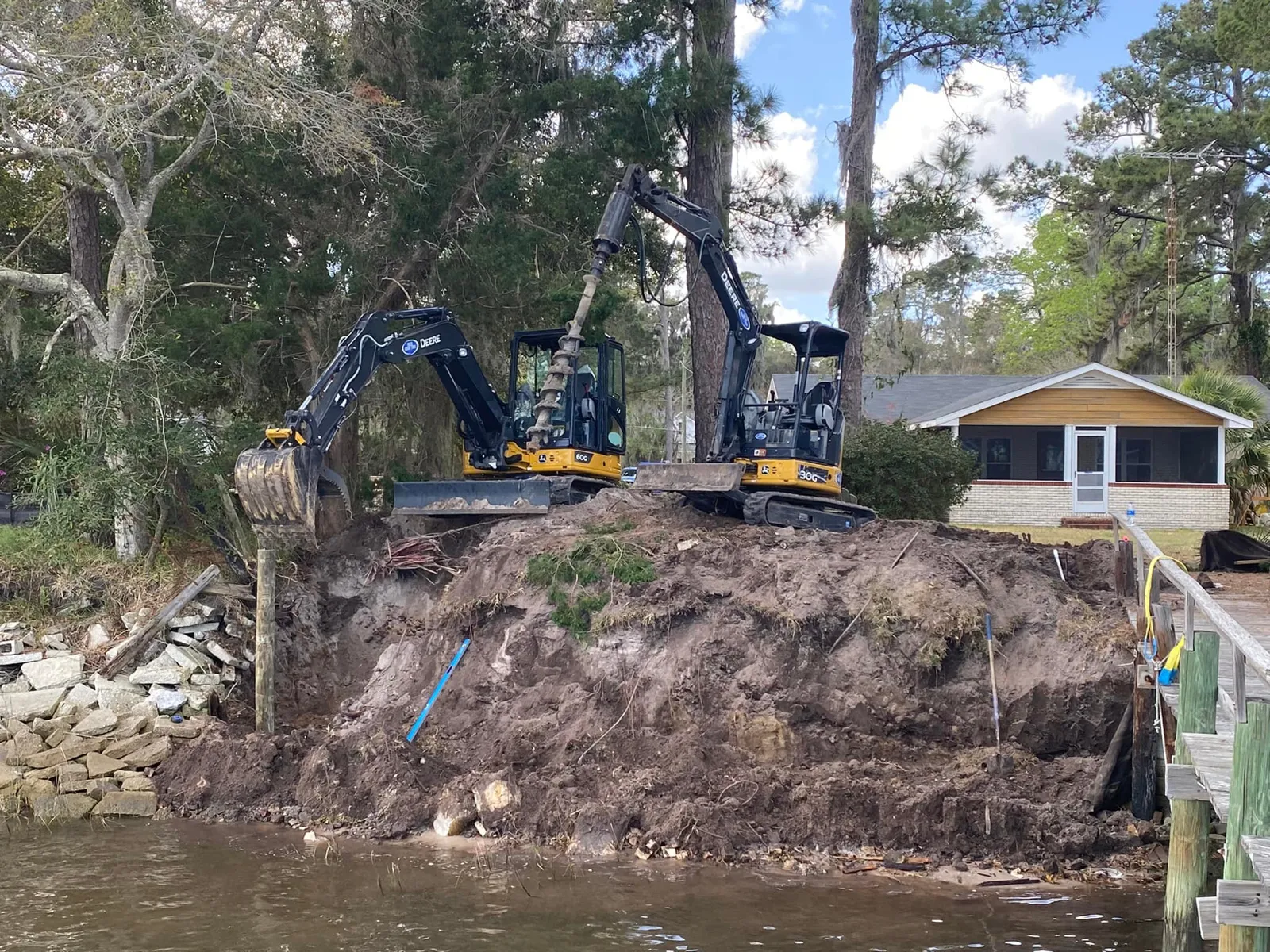
Our crew restoring an eroded bank along the water.
What Are the Warning Signs?
Missing stones or stones rolled to the bottom
Sagging or flattened parts of the slope
Fabric showing or torn
Soil or sand washing between rocks
An undercut toe
Erosion at the ends, where rock meets a wall or natural bank
The ends usually go first. Water wraps around them and digs in.
When Should I Inspect My Jacksonville Revetment?
When
What to check
Spring, before hurricane season
Full walk; reset loose stone; repair fabric
After a nor'easter
Rock moved by wind-driven waves; toe scour
After any tropical storm or hurricane
Displaced armor; end washouts
Once a year
Slope profile, vegetation, transitions
Nor'easters matter here as much as hurricanes. Before Irma, a nor'easter had already swelled the St. Johns, and the two together produced record flooding in parts of the city.
Why Does Location on the River Change the Plan?
A revetment near Mayport lives a very different life from one upriver. NOAA's datums put the daily range at about 4.9 feet at Mayport, about 1.9 feet at the Southbank Riverwalk downtown, and roughly 1 foot at the Buckman Bridge (NOAA).
Near the mouth and on the Intracoastal: water runs up and down a tall band of the slope every day, so wear is spread out and the toe takes constant work.
Upriver: daily swings are small, so the same band of stone takes waves and wake day after day, and storm flooding is the bigger threat.
Knowing which pattern your shoreline follows tells us where to look first and how often to come back. Both are rising. NOAA's Mayport gauge shows sea level going up about 1.15 inches per decade since 1928. Older revetments now take waves higher on the slope than when they were built. During Irma, the Mayport gauge peaked at 3.6 feet above mean higher high water, and upriver gauges went higher.
What Does Maintenance Involve?
Routine
Resetting displaced stones into the interlock
Adding stone where the slope has thinned
Clearing debris and checking for voids
Rehabilitation
Toe rebuilds where bottom rock is undermined
Fabric replacement under lifted stone
Re-grading slumped sections
Tie-ins where rock meets a neighboring bulkhead
Work that stays inside the revetment's existing footprint is usually simpler to approve than expanding it. If the slope needs to grow, we'll confirm state and federal requirements first.
How Much Does Revetment Maintenance Cost in Jacksonville?
Routine revetment maintenance in Jacksonville generally runs $1,500–$5,000 per year for a standard 100-foot residential revetment. Major rehabilitation runs $150–$400 per linear foot.