A Brunswick rock revetment needs a yearly inspection, a look after spring tides, and a check after every tropical storm, so moved stone and washouts are fixed before the bank behind them erodes.
✓ Brunswick Experts✓ Licensed in GA & SC✓ Free Inspections✓ 30 Years Experience
Quick Answer
Seawall Repairs by Solid Foundations provides revetment maintenance in Brunswick, GA for riverfront homeowners, HOAs, and commercial and industrial waterfront owners. Typical projects include resetting stone moved by storm surge, rebuilding undercut toes on tidal river banks, repairing torn filter fabric, and fixing washouts where rock meets a bulkhead. Call 866-398-9323 or use the quote form to book a free on-site inspection.
What Is a Revetment?
A revetment is a sloped rock bank. Big armor stone sits over smaller stone and filter fabric, and the slope takes the force of waves instead of reflecting it. On a tidal river, it also holds the bank against current. It lasts a long time, but it isn't set-and-forget. Stones shift, fabric gets exposed, and the toe gets undercut a little at a time.
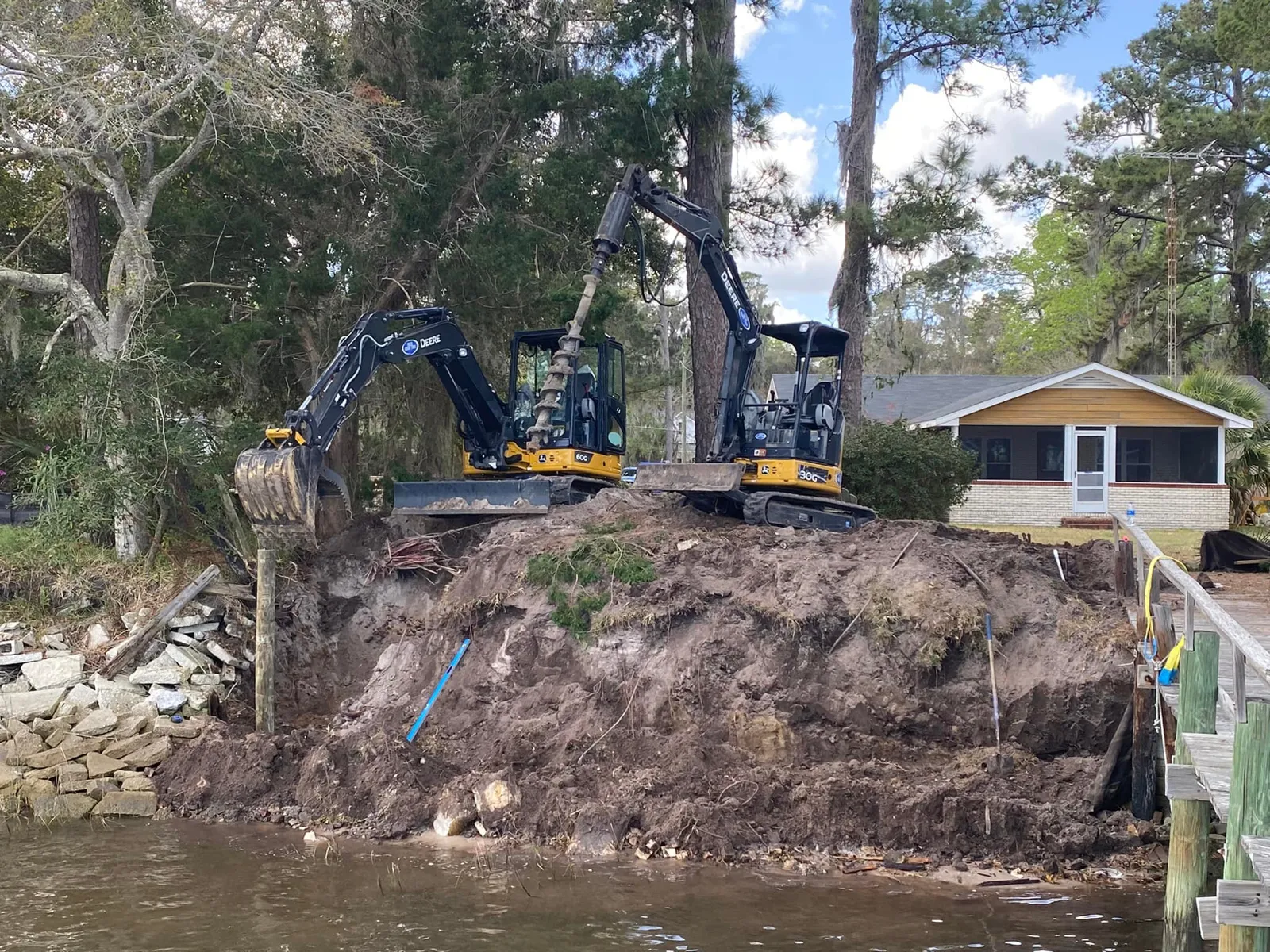
Our crew restoring an eroded bank along the water.
What Are the Warning Signs?
Missing or rolled stones on the slope
Slumped or flattened sections
Visible or torn filter fabric
Sediment washing out between stones
An undercut toe on the bottom row
Erosion at the ends where rock meets a wall or natural marsh bank
Ends fail first. Current and waves curl around them and dig in behind.
When Should I Inspect My Brunswick Revetment?
When
What to check
Spring, before hurricane season
Full walk at low tide; reset loose stone; patch fabric
After spring tides and king tides
Washout along the highest waterline
After any tropical storm or strong nor'easter
Displaced armor, toe scour, end washouts
Once a year
Slope shape, transitions, plant growth
Why Do Brunswick Revetments Work So Hard?
It comes down to how much of the slope the tide covers. The Georgia DNR Coastal Resources Division says coastal tides average about 6½ feet in the marshes and top 10 feet on spring tides (GA DNR CRD). NOAA's Brunswick gauge at Howe Street Pier shows about 7.7 feet between mean higher high water and mean lower low water. Where tides are small, the water works on a narrow band of rock. Here it climbs and drops across most of the slope twice a day, so the whole revetment, from toe to crest, gets worked.
Storms add to that. The Hurricane Center measured 3 to 5 feet of inundation along the Georgia coast during Irma in 2017 (NHC). Surge on top of a high tide pushes waves onto the crest, where stones are often smallest and least tied in.
What Does Revetment Maintenance Involve?
Routine
Resetting displaced armor stone
Adding stone where the slope has thinned
Clearing debris and wrack
Checking for voids under the surface layer
Rehabilitation
Toe rebuilds where current has undercut the bottom row
Fabric replacement under lifted stone
Re-sloping slumped sections
Tie-ins where rock meets a bulkhead or marsh bank
Work outside the existing footprint on a tidal bank needs CRD review. We keep maintenance inside the footprint where we can and call CRD before starting.
How Much Does Revetment Maintenance Cost in Brunswick?
Routine revetment maintenance in Brunswick typically costs $1,500–$5,000 per year for a standard 100-foot residential revetment. Major rehabilitation runs $150–$400 per linear foot.