If your Brunswick seawall or bulkhead is leaning but not broken, new anchors can stop the movement, usually for well under half the cost of replacing it.
✓ Brunswick Experts✓ Licensed in GA & SC✓ Free Inspections✓ 30 Years Experience
Quick Answer
Seawall Repairs by Solid Foundations provides seawall reinforcement in Brunswick, GA for marsh-front homeowners, HOAs, and commercial waterfront owners. Typical projects include helical tiebacks on walls that shifted during Irma's flooding, new anchors behind aging East River bulkheads, and walers on long runs of tidal creek wall. Call 866-398-9323 or use the quote form to book a free on-site inspection.
Is Your Wall a Good Candidate?
Reinforcement works when the wall is intact but moving:
The top tilts toward the water.
The middle bows out.
Cracks open between the cap and your deck.
The wall moved in a storm but didn't break.
The original tie rods have rusted or the anchors have pulled.
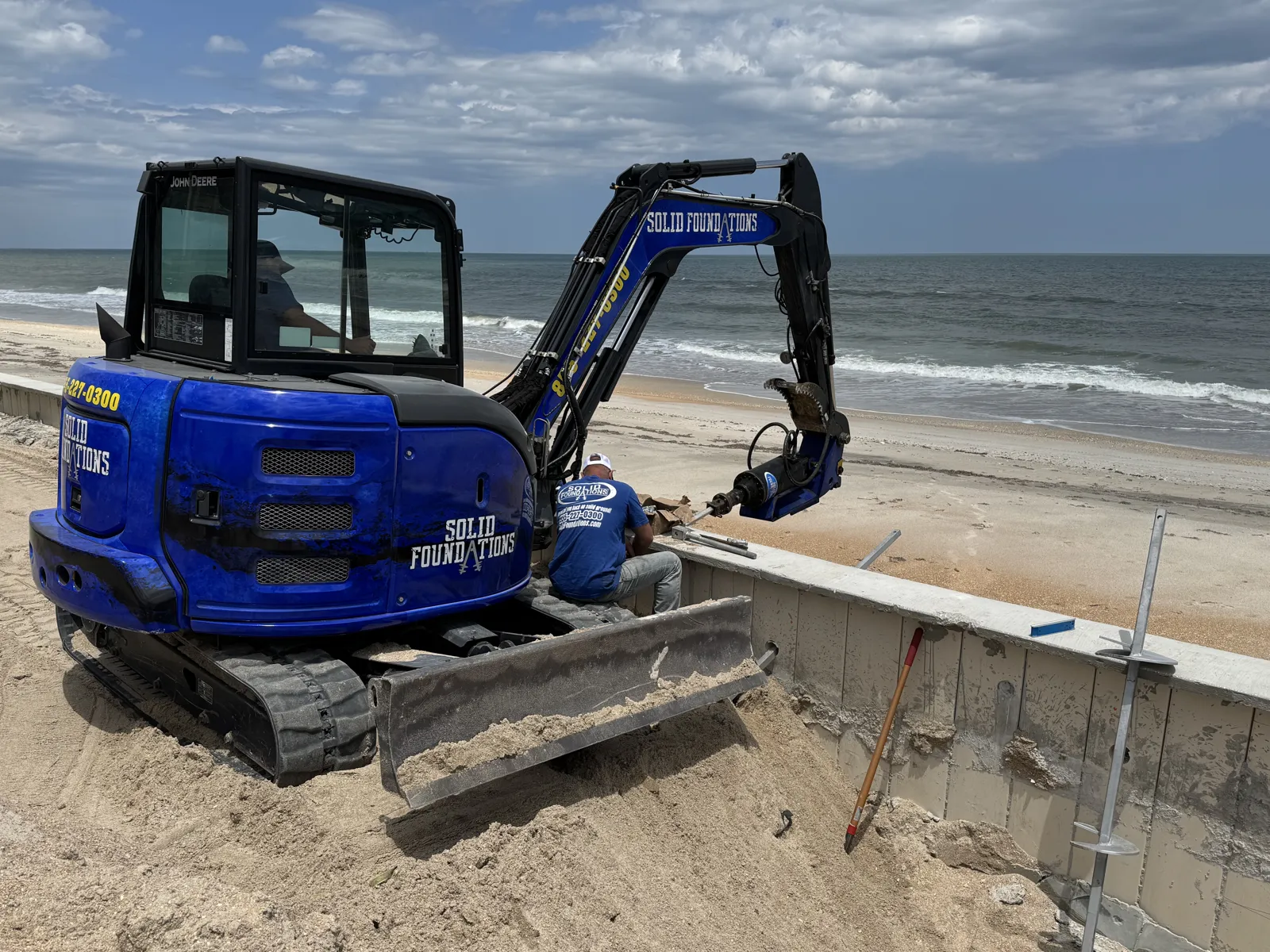
Helical tiebacks going in on a beachfront seawall.
What Pushes Brunswick Walls Over?
Low tide, every tide
A wall holds back wet soil. At high tide, water in front pushes back and helps. At low tide, that help drops away. In Brunswick, the daily range is about 7.7 feet at NOAA's Howe Street Pier gauge. Twice a day, your wall carries the full load of saturated soil with very little water in front. Weak anchors give a little each time.
High water that didn't leave
During Irma in 2017, Glynn County's emergency director said a nor'easter held water in the marshes, and "there never really was a low tide" for two tidal cycles. Nearly 10 inches of rain fell on top of it (GovTech). Soil behind walls got soaked through. When the water finally went out, many walls took a heavy push.
Soft ground behind the wall
Marsh-front soil is often soft and organic, which gives old anchors less to grip. A deadman buried in that kind of soil can slowly drag toward the wall under load, and as it moves, the wall leans with it. That's why so many older Brunswick walls lean evenly along their whole length rather than at one spot. The anchors behind them have crept, and the fix is new anchors that reach firmer ground.
Which Reinforcement Methods Fit?
Helical tiebacks
Steel shafts with screw plates go in at an angle through the wall into firmer soil behind it and lock off at the face. We read the installation torque on each one to confirm it's holding. In soft marsh soil, that often means longer anchors. See helical tiebacks.
Deadman anchors
Where there's room behind the wall, a buried concrete anchor tied back with rods is a proven option.
Walers
A continuous beam across the wall face spreads anchor loads so no single panel takes too much.
A comprehensive reinforcement program for an 80-foot Brunswick wall typically costs $12,000–$35,000, versus $40,000–$80,000 for replacement.
Does Reinforcement Need State Approval?
Talk to CRD first. The Coastal Resources Division asks owners to contact it before maintenance on an existing structure. Anchors installed from the land side behind the wall usually stay out of the marsh, which keeps things simpler. We're licensed to perform marine construction in Georgia and South Carolina and will make those calls. If structures near your wall are sinking too, see marine foundation repair in Brunswick.