✓ Jacksonville Experts✓ Licensed CBC1267322✓ Free Inspections✓ 30 Years Experience
Quick Answer
Seawall Repairs by Solid Foundations provides seawall reinforcement in Jacksonville, FL for riverfront homeowners, HOAs, and commercial properties. Typical projects include helical tiebacks on walls that shifted in Irma's flooding, replacing corroded tie rods on older St. Johns River bulkheads, and adding walers to long runs on the Intracoastal. Call 866-398-9323 or use the quote form to book a free on-site inspection.
When Is Reinforcement the Right Fix?
It fits walls whose panels are sound but which are on the move:
The cap tilts toward the water.
The middle of the wall bulges out.
Cracks open between the cap and your patio.
The wall shifted during a flood but held together.
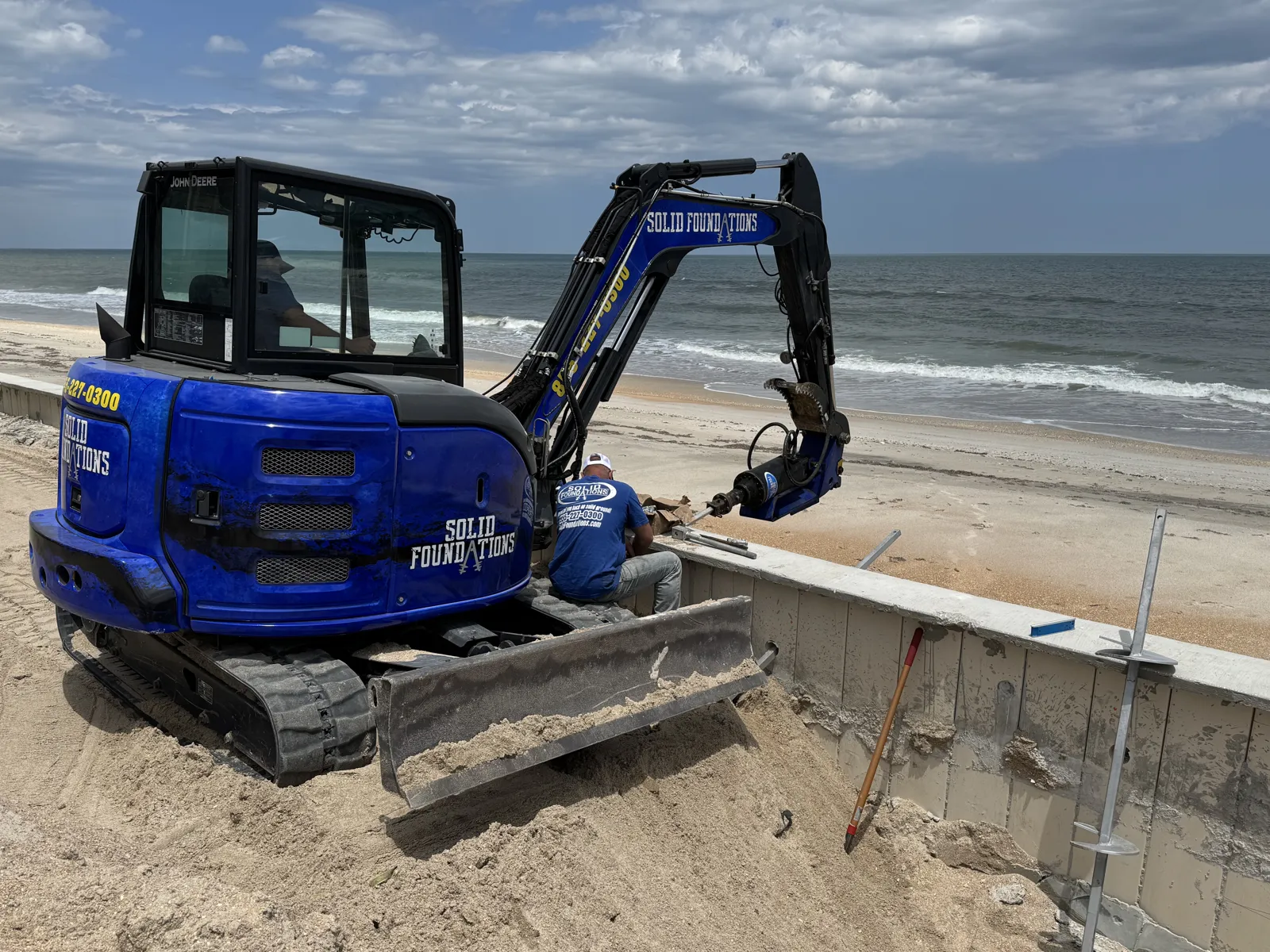
Helical tiebacks going in on a beachfront seawall.
Why Do Jacksonville Seawalls Lean?
High water that stayed high
Irma didn't just bring a quick surge. A nor'easter had already swelled the St. Johns before the storm arrived. On the river, the Hurricane Center recorded peaks of 5.3 feet above mean higher high water at the I-295 bridge and 4.9 feet at the Southbank Riverwalk (NHC). When high water sits against a wall and then drops away, the soaked soil behind it pushes out hard. Walls that survived can keep creeping afterward.
Soggy backfill
Summer storms and river flooding soak the soil behind walls. Wet soil weighs more, and clogged weep holes keep that weight in place.
Worn-out anchors
Many older walls rely on steel tie rods tied to a buried "deadman." In brackish and salt water, those rods rust thin over the decades.
Tide swings near the coast
On walls close to the mouth and along the Intracoastal, the water drops close to 5 feet between high and low tide on NOAA's Mayport datums. At low tide, the full weight of wet soil pushes on the wall with little water on the other side to push back. Every cycle is a small test, and after thousands of them, a weak anchor lets go. Walls upriver see smaller swings but take the bigger hit when floods like Irma's recede.
What Methods Do We Use?
Helical tiebacks
Steel shafts with screw plates are drilled at an angle through the wall into firm soil behind it and locked to the wall face. They act as new tie rods. Most jobs take a day or two. See helical tiebacks.
Deadman anchors
On lots with open yard behind the wall, a buried concrete anchor tied back with rods is a reliable option.
Walers
A continuous beam along the face spreads the load across panels, which helps on long runs.
A comprehensive reinforcement program for an 80-foot Jacksonville wall usually costs $12,000–$35,000, compared with $40,000–$80,000 to replace it. Many owners anchor now and plan a replacement years later.
How Do We Make Sure the Anchors Hold?
Before setting tiebacks, we confirm they'll reach soil strong enough to hold. We track the torque as each helical anchor goes in, which tells us when it has reached load-bearing ground. Where the upper soil is soft, we go longer or add anchors. If structures near your wall are also sinking, see marine foundation repair in Jacksonville. Our Jacksonville seawall repair page covers the rest of our services. We also reinforce walls in Savannah.
Seawall Reinforcement FAQs: Jacksonville
My seawall leaned after Irma and hasn't moved much since. Should I still anchor it?
Yes, if the panels are intact. The next big flood will load it again. Anchoring now keeps more options open.
Will tiebacks go under my pool or driveway?
They're installed at an angle below ground. We locate pools, pipes and irrigation first and route around them.
Is reinforcement a permanent fix in Jacksonville?
Properly engineered anchors are permanent. The wall's overall life still depends on the panels, and we'll be clear about that.
Do I need a permit to reinforce my wall in Jacksonville?
Structural work generally does, through the City of Jacksonville or your beach city if you live there. We prepare it.