A rock revetment on Hilton Head should be inspected once a year and after every tropical storm, so displaced stone and exposed fabric get fixed before the bank behind them erodes.
✓ Hilton Head Experts✓ Licensed in GA & SC✓ Free Inspections✓ 30 Years Experience
Quick Answer
Seawall Repairs by Solid Foundations provides revetment maintenance in Hilton Head Island, SC for homeowners, property owners' associations, condo regimes, and marinas. Typical projects include resetting armor stone knocked loose by storms, rebuilding toes along creek and sound-side slopes, and repairing torn filter fabric. Call 866-398-9323 or use the quote form to book a free on-site inspection.
What Is a Revetment and Why Keep It Up?
A revetment is a sloped bank of armor rock over smaller stone and filter fabric, built to absorb wave energy instead of throwing it back. It's tough, but storms, wakes, and tidal currents shift stones over time.
Oceanfront structures carry a special rule. Under South Carolina beachfront rules, a grandfathered erosion control structure may be maintained in its present condition but not enlarged, strengthened, or rebuilt, and if it's destroyed, it must be removed at the owner's expense. So on the beach side, timely maintenance protects your right to keep the structure at all. On creeks and sounds, SCDES notes that normal maintenance and repair may not need a critical area permit.
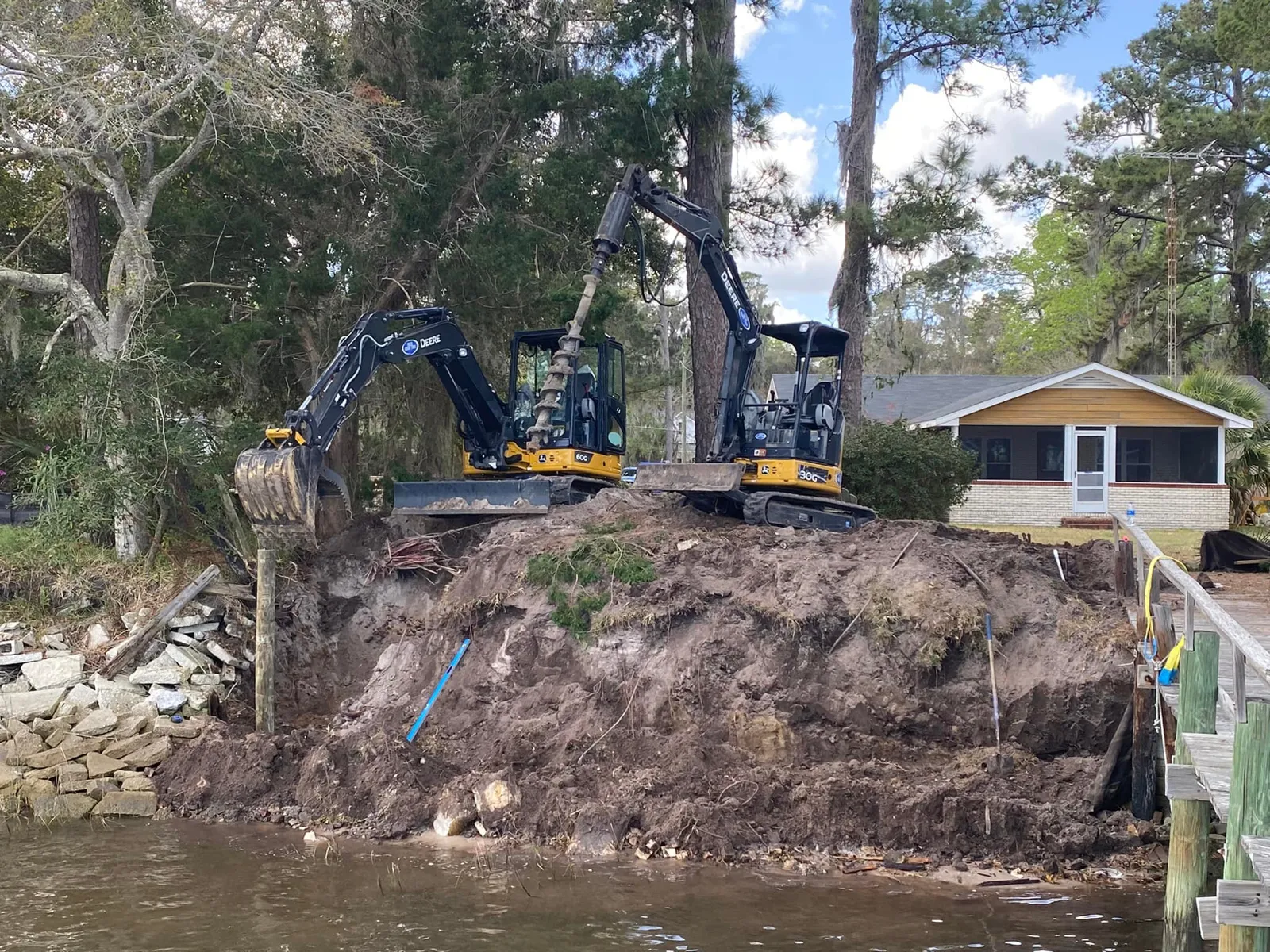
Our crew restoring an eroded bank along the water.
Which Warning Signs Matter Most?
Stones missing from the slope or scattered below it
Slumped areas where the slope has flattened
Exposed or torn fabric
Soil washing out between stones
A sinking or scoured toe
Erosion at the ends, where rock meets a wall or natural bank
What Should an Inspection Calendar Look Like?
When
What to look for
Spring
Full walk-down before storm season; reset stone; fabric fixes
After any tropical storm
Displaced armor, toe scour, end washouts
After the year's highest tides
Washouts along the top of the slope
Annually at a very low tide
Toe condition and transitions
A low tide matters. With creek tides on the island reaching 7 feet or more, the toe is only visible for a short window.
What Does Maintenance Include?
Routine
Resetting displaced stones
Adding stone where the slope has thinned
Clearing debris and marsh wrack
Rehabilitation
Toe rebuilds
Fabric replacement
Slope regrading
End tie-ins to neighboring structures
Why Do Island Revetments Take Such a Beating?
Hilton Head faces several energetic waters at once: the Atlantic, Port Royal Sound, and big tidal creeks. The nearby Fort Pulaski gauge, which NOAA uses as the reference for the island's tide predictions, hit 12.56 feet during Matthew, its highest on record (NWS Charleston). Water at that height tops most rock slopes and works on the upper edge, where stones are usually smallest.
The Town's approach to its own shoreline shows how seriously erosion is taken here. It has renourished its beaches in 1990, 1997, 2006, 2016, and again in 2025–26, and plans to repeat that every 8 to 10 years. Private revetments on the sound and creeks don't get that kind of periodic rebuild, so steady maintenance is what keeps them working. A few reset stones each year cost far less than rebuilding a slope that was left to unravel.
How Much Does Revetment Maintenance Cost on Hilton Head?
Routine revetment maintenance in Hilton Head typically runs $1,500–$5,000 per year for a standard 100-foot residential revetment. Major rehabilitation runs $150–$400 per linear foot. Ongoing care costs much less than a rebuild.
Not under South Carolina's beachfront rules. Grandfathered structures may be maintained in their present condition but not enlarged, strengthened, or rebuilt.
What happens if a storm destroys my grandfathered beachfront structure?
State rules say it must be removed at the owner's expense. That's one reason to keep it maintained.
How often should a sound-side revetment be inspected?
Once a year, ideally in spring, and after any tropical storm.
My rock slope ends at my neighbor's bulkhead, and that spot keeps eroding. Why?
Water wraps around the end of the rock and digs behind it. A proper tie-in at the transition solves it.