A Charleston seawall that has started to lean but still has solid sheeting can usually be stopped in its tracks with helical tiebacks, at roughly half the price of rebuilding it.
✓ Charleston Experts✓ Licensed in GA & SC✓ Free Inspections✓ 30 Years Experience
Quick Answer
Seawall Repairs by Solid Foundations provides seawall reinforcement in Charleston, SC for homeowners, HOAs, and commercial properties. Typical projects include helical tiebacks on bulkheads pushed out by Irma's storm tide, walers on long harbor-side runs, and new anchors where old tie rods have rusted through on Ashley River walls. Call 866-398-9323 or use the quote form to book a free on-site inspection.
Is Reinforcement the Right Call?
It fits walls that are moving but not broken:
The cap tips toward the water a little more each year.
A bulge is forming along the run.
Cracks and gaps open between the cap and your lawn or deck.
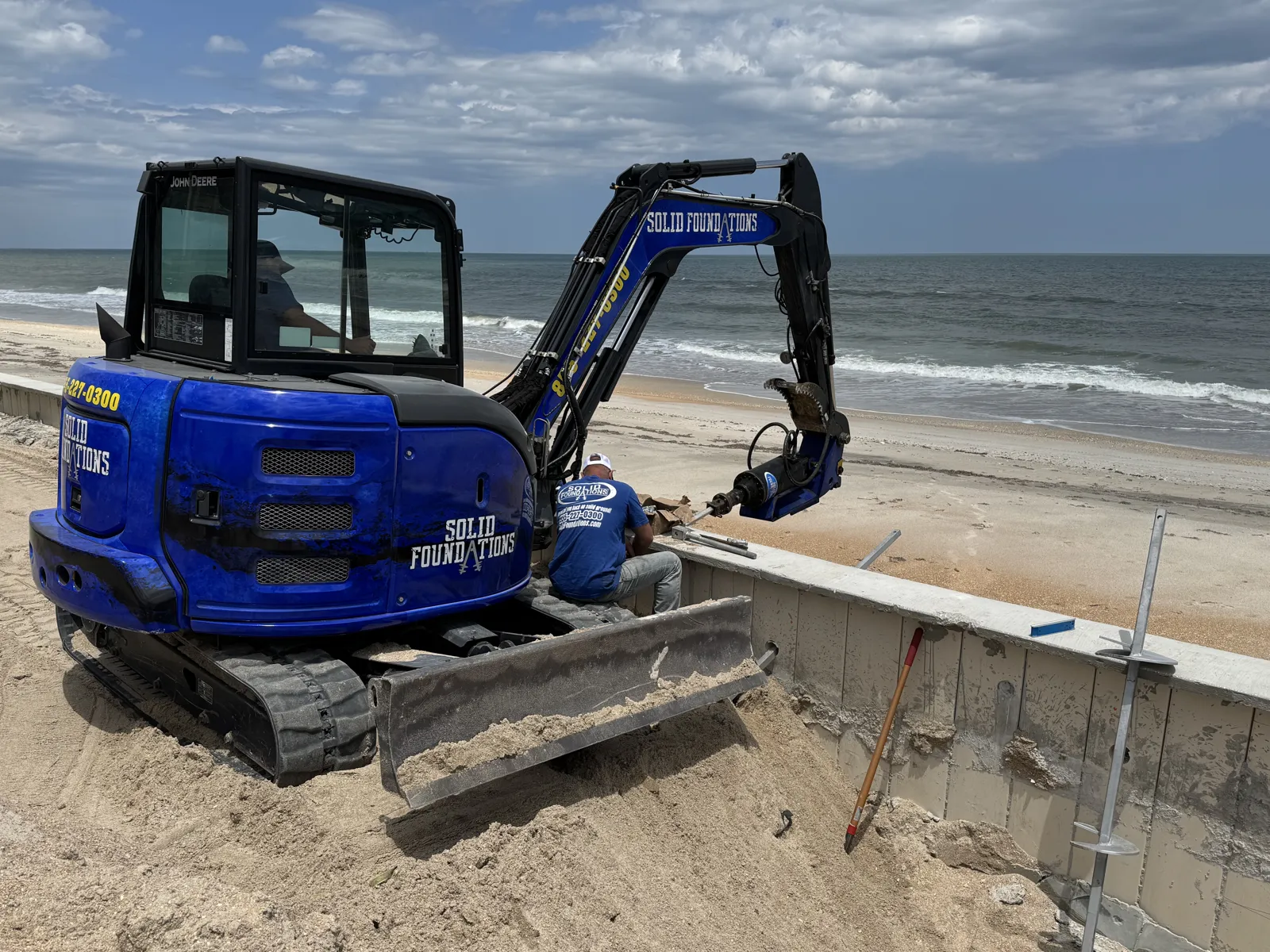
Helical tiebacks going in on a beachfront seawall.
Why Are Charleston Walls Leaning?
Back-to-back storm tides. Matthew pushed Charleston Harbor to 9.29 feet above mean lower low water in October 2016 (NWS Charleston). Eleven months later, Irma topped that at 9.92 feet, the third-highest level on record at the time. Two soakings that deep, a year apart, loaded the fill behind many walls well past normal. Some walls that looked fine afterward have been drifting outward ever since.
Heavier soil behind the wall. When the fill stays wet, it weighs more and pushes harder. Clogged weeps make it worse.
Tired anchors. Older creek bulkheads often rely on steel rods and buried deadmen. Decades of salt water thin those rods until they stretch or snap.
How Do We Reinforce Charleston Seawalls?
Helical tiebacks
Steel shafts with screw-shaped plates are drilled through the wall at an angle and into firm soil, then tensioned and locked off. Each one acts as a brand-new anchor. On most homes, installation takes a day or two, and the yard is barely disturbed. Details on helical tiebacks.
Micropiles and added support
The City of Charleston used micropiles to carry its rebuilt Low Battery wall. On private walls, we look at whether added vertical support makes sense alongside anchors when the soil is especially soft.
Walers
A beam along the face spreads anchor loads across the run so no single panel takes the strain.
Drainage and void fill
We often add polyurethane void fill and relief drains so the wall isn't fighting the same pressure again.
What Does Reinforcement Cost Compared With Replacement?
Reinforcement
Full replacement
Typical 80-ft residential wall
$12,000–$35,000
$40,000–$80,000
Time on site
Usually 1–3 days
Usually 1–3 weeks
Disruption
Minimal
Significant
Approvals
Usually simpler
Engineering plus SCDES and federal review
Reinforcing now and planning a replacement later is a sensible path for many owners. It spreads the cost over years, keeps your dock and landscaping in service, and gives you time to decide on materials and cap height for the eventual new wall. We'll give you an honest estimate of how many years the sheeting has left so you can plan around a real number.
Why Check the Ground Before Anchoring?
Charleston's creek-front lots often grade from sandy upland into soft pluff mud at the marsh edge. An anchor set in that mud won't hold much. We push tiebacks through to firmer soil and read the installation torque on every one to confirm capacity. If your dock or deck is settling too, see marine foundation repair in Charleston. You'll find our other local work at Charleston seawall repair.
My wall started leaning after Irma. Is it too late to anchor it?
Usually not. If the sheeting is intact, tiebacks can stop the movement, and some walls can be pulled partway back. The earlier we see it, the more options you have.
Will tiebacks hurt the live oaks in my yard?
We map large roots, utilities, and irrigation before drilling and angle the anchors to avoid them.
Does reinforcing a bulkhead need an SCDES permit?
It depends on the scope. SCDES treats some work as normal maintenance and repair, while structural changes can need a critical area permit. We check first.
Is reinforcement a permanent fix in Charleston?
The anchors are permanent. The rest of the wall's life depends on the sheeting's condition, and we'll tell you where it stands.