A rock revetment in Charleston should get a yearly inspection and a check after every storm or unusually high tide, so rolled stones and exposed fabric get fixed before the bank behind them erodes.
✓ Charleston Experts✓ Licensed in GA & SC✓ Free Inspections✓ 30 Years Experience
Quick Answer
Seawall Repairs by Solid Foundations provides revetment maintenance in Charleston, SC for homeowners, HOAs, condo communities, and marinas. Typical projects include resetting armor stone after king tides, rebuilding toes that have sunk into soft mud, and repairing torn filter fabric on harbor and river-front slopes. Call 866-398-9323 or use the quote form to book a free on-site inspection.
What Is a Revetment and Why Maintain It?
A revetment is a rock-armored slope: big stones on top of smaller stone and filter fabric, designed to soak up wave energy rather than reflect it. It's strong, but not maintenance-free. Wakes, storm tides, and currents shift stones a little every season, and the soft ground underneath can let the toe sink over time.
In South Carolina, revetments on tidal water are regulated alongside bulkheads by the SCDES Bureau of Coastal Management. SCDES says normal maintenance and repair may not need a critical area permit, while changing or expanding the structure can.
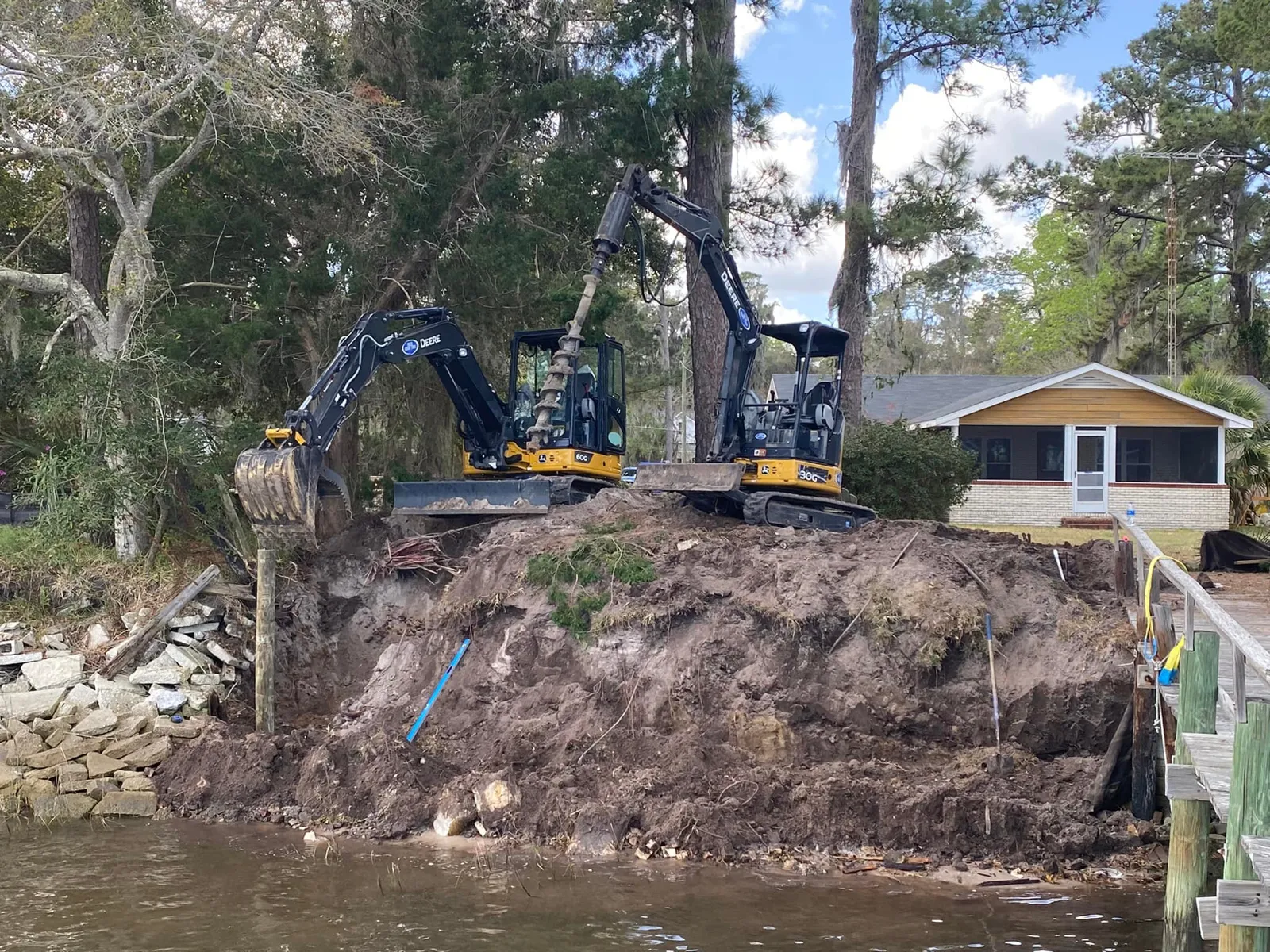
Our crew restoring an eroded bank along the water.
Which Warning Signs Should You Watch For?
Stones missing from the upper slope or sitting in the mud below
Flattened sections where the slope has sagged
Fabric exposed, torn, or flapping
Soil washing out between stones at high water
The bottom row sinking into pluff mud
Scour at the ends where rock meets a bulkhead or natural bank
When Should a Charleston Revetment Be Inspected?
Timing
Focus
Spring, before hurricane season
Full check; reset loose stone; fabric repairs
After a named storm
Displaced armor, toe damage, end washouts
After king tide events
Washouts along the top edge of the rock
Yearly, at a low tide
Toe settlement, slope shape, transitions
What Does the Work Involve?
Routine care
Resetting displaced stones into the interlock
Adding stone where the slope has thinned
Clearing debris and wrack
Rehabilitation
Toe rebuilds where the bottom row has sunk or scoured
Fabric replacement under lifted stone
Slope rebuilding to a stable angle
End tie-ins to adjacent walls
Why Do Charleston Revetments Need Extra Attention Now?
The water is higher than it used to be. NOAA's Charleston Harbor gauge, with records back to 1901, shows relative sea level rising about 1.4 inches per decade. The city has seen more frequent king tides, and officials pointed to them, along with storm surge and heavier rain, when they rebuilt the Low Battery seawall (WCSC Live 5).
For a revetment, that means waves reach the upper slope more often. The upper stones are usually the smallest and easiest to move. A slope sized decades ago may now take regular hits on rock that was meant to stay dry most of the year. Add pluff mud at the toe, which lets the bottom row settle, and you get slopes that slowly steepen and slump. That's why we check both ends of the slope on every visit.
How Much Does Revetment Maintenance Cost in Charleston?
Routine revetment maintenance in Charleston typically runs $1,500–$5,000 per year for a standard 100-foot residential revetment. Major rehabilitation runs $150–$400 per linear foot. Keeping up with it costs far less than a rebuild.
How often should a Charleston revetment be inspected?
At least once a year, ideally in spring, plus after any named storm or a run of very high tides.
Do I need an SCDES permit to reset stones on my existing revetment?
Routine work that keeps the same footprint may qualify as normal maintenance and repair. Expanding or reshaping it usually needs a permit. We confirm before starting.
Why is the bottom of my rock slope disappearing?
In soft pluff mud, the toe stones can slowly settle. A toe rebuild on a better base fixes it.
Are king tides really a problem for rock revetments?
They can be. Higher water puts wave action on the upper slope, where the stones are smaller and easier to move.