Replace a Charleston bulkhead when it's rotated beyond anchoring, broken through, or rotten along most of its length. Vinyl or composite sheet pile, set at a height that accounts for rising water, is the long-lasting choice for most creek-front homes.
✓ Charleston Experts✓ Licensed in GA & SC✓ Free Inspections✓ 30 Years Experience
Quick Answer
Seawall Repairs by Solid Foundations provides bulkhead replacement in Charleston, SC for homeowners, HOAs, and marinas. Typical projects include swapping failing timber bulkheads on James Island and West Ashley creeks for vinyl sheet pile, rebuilding walls damaged by the storm tides of Matthew and Irma, and matching new caps to neighbors along the Ashley River. Call 866-398-9323 or use the quote form to book a free on-site inspection.
What Tells You It's Time to Rebuild?
The top has rotated too far to anchor back safely.
The toe has pushed out into the creek or pluff mud.
Timber is punky or chewed through along most of the run.
Panels or sheets have split, letting water pass at low tide.
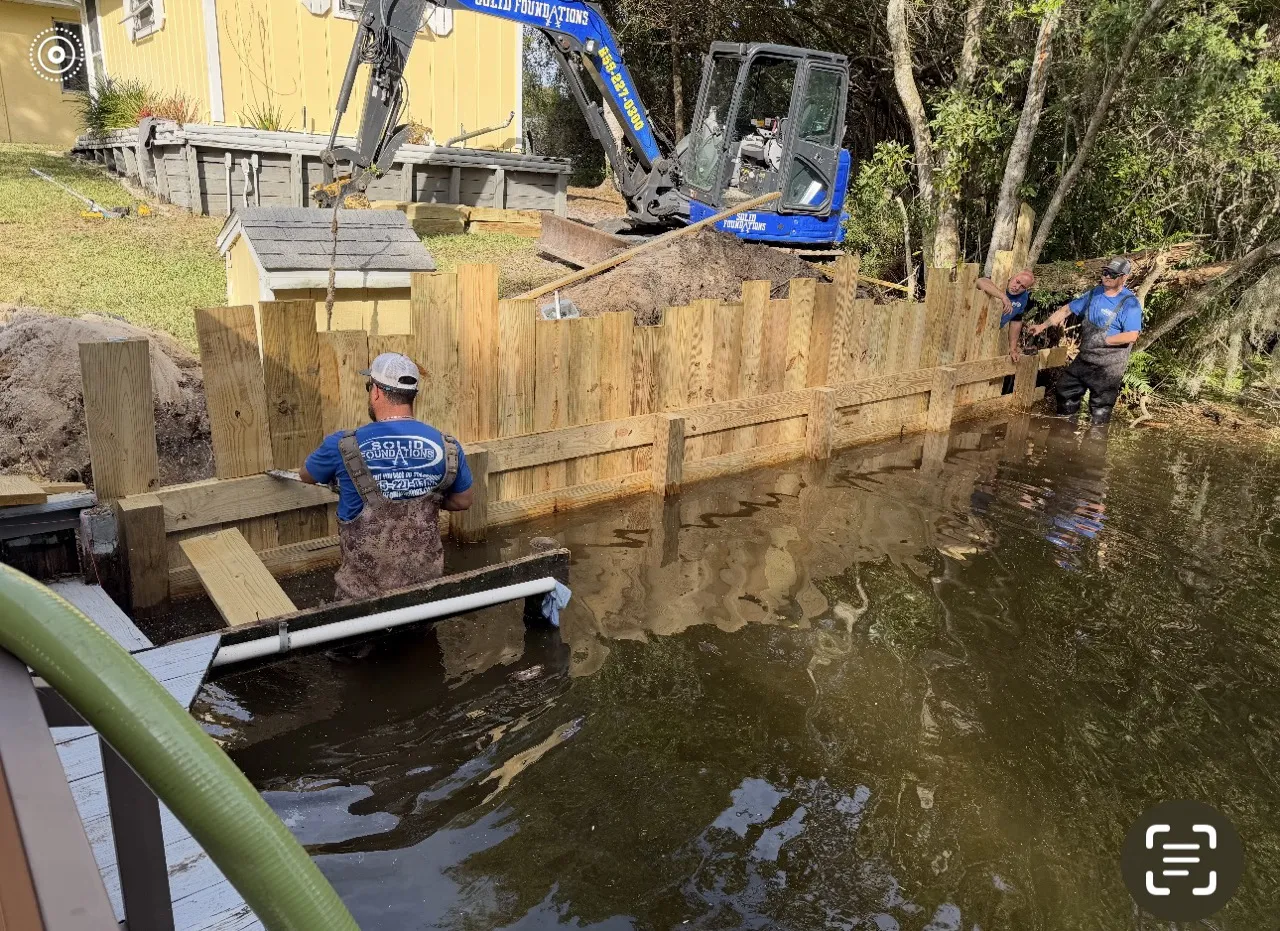
Our crew setting a new bulkhead from the water side.
Which Materials Hold Up Best in Charleston?
Material
Typical lifespan*
Why owners pick it
What to watch
Vinyl sheet pile
40–50+ yrs
No rot, rust, or borers
Needs a solid cap and anchors
Composite (FRP) sheet pile
50+ yrs
Stiff and very durable
Higher material cost
Treated timber
15–25 yrs
Classic Lowcountry look, lower cost
Rot and borers in salt water
Steel sheet pile
25–40 yrs in salt water
High loads, commercial sites
Corrosion without protection
Precast concrete
30–50 yrs
Matching an existing concrete run
Heavy; joints need sealing
*Service life varies with exposure, installation, and maintenance.
For most Charleston creek lots, we recommend vinyl or composite sheet pile with a cast concrete or timber cap, driven deep enough to hold in soft marsh mud.
How High Should a New Charleston Wall Be?
This is the question that matters most here. The City of Charleston faced it on its own seawall. When it rebuilt the Low Battery, first built on reclaimed land between 1909 and 1919, it raised the wall 1.8 feet to match the High Battery. It also adopted a rule that new city projects with a design life of 50 years or more must plan for 2.5 feet of sea level rise (City of Charleston).
That rule covers city projects, not your backyard wall. But it's a useful benchmark. We'll talk through cap height with you, and we'll plan transitions to your neighbors' walls so a taller cap doesn't create a low spot next door.
What Do SC Rules Say About Where the Wall Goes?
South Carolina's critical area rules require a bulkhead to follow the critical area line as closely as possible. They allow construction up to 18 inches from the existing escarpment. They also bar new bulkheads where healthy marsh is already buffering erosion, unless upland is being lost to tidal erosion (SC Reg. 30-12). On oceanfront beaches, new erosion control structures aren't allowed at all. We plan the alignment with those rules in mind from day one.
How Long Does Replacement Take?
Inspection and quote: usually the first week
Survey, critical line, and engineered plans: often 2–4 weeks
SCDES and federal approvals: timing depends on agency workload, which grows after storms
Construction: typically 1–3 weeks for a home, worked around the tide
Backfill, cap, and final cleanup
How Much Does Bulkhead Replacement Cost in Charleston?
Bulkhead replacement in Charleston typically costs $250–$600 per linear foot for a full replacement. A 75-foot residential vinyl sheet pile replacement typically runs $20,000–$45,000. Wall height, sheet length, access, and any toe rock affect the final number.
Should my new bulkhead be taller than the old one because of sea level rise?
Often it makes sense to consider it. Charleston's tide gauge shows steady rise, and the city now designs its own long-life projects for 2.5 feet more water. We'll weigh the height against drainage and your neighbors' walls.
Can I build a new bulkhead where there's marsh in front of my yard?
South Carolina generally bars new bulkheads where marsh is adequately buffering erosion. If upland is actively washing away, there may be a path. We'll assess it honestly.
Can I put a seawall in front of my house on Folly or the Isle of Palms beach?
No new erosion control structures are allowed on South Carolina's beaches or beach/dune system. Our replacement work is on creeks, rivers, and the harbor.
How long will a vinyl bulkhead last in Charleston?
Commonly 40 to 50 years or more with a good cap and anchors, well beyond typical treated timber.