A Key West bulkhead that is still upright can usually be repaired where it stands, by sealing leaks, filling voids and rebuilding spalled concrete, instead of being torn out.
✓ Key West Experts✓ Licensed CBC1267322✓ Free Inspections✓ 30 Years Experience
Quick Answer
Seawall Repairs by Solid Foundations provides bulkhead repair in Key West, FL for canal homeowners, condo associations, and marina and commercial owners. Typical projects include patching salt-spalled caps along Riviera Canal, sealing seeping joints on New Town canal walls, and filling hollow spots behind walls near Garrison Bight. Call 866-398-9323 or use the quote form to book a free on-site inspection.
Is My Key West Bulkhead Worth Repairing?
Most of the time it is. The deciding question is simple: is the wall still standing straight, with its panels in one piece? If so, the trouble is usually at the joints, in the cap, or in the fill behind it, and all three can be fixed in place.
Take a slow walk along your wall and note anything like this:
Rust-colored stains bleeding through the concrete face
Chunks of concrete popping off the cap, exposing steel
Hairline or open cracks running down a panel
Pavers or lawn dipping a few feet back from the water
Milky water at the foot of the wall after a hard rain
A widening gap between the cap and your deck
Two or three of these on a straight wall point to repair. A wall that leans or has holes punched through it needs a different conversation. See bulkhead replacement in Key West.
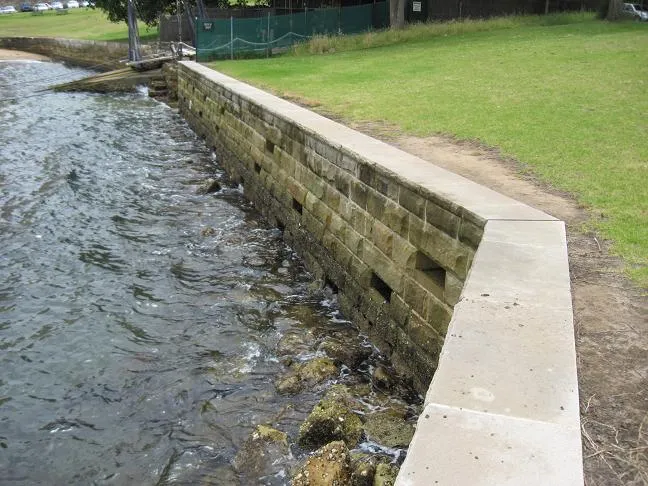
A concrete seawall and cap after repair work by our crew.
What Wears Out Bulkheads in Key West?
Salt, sun and steel
Concrete walls in the Keys sit in warm salt water and salt spray all year. Once salt reaches the reinforcing steel, the steel rusts and swells, and that pressure pops the concrete off in flakes. That's "spalling," and it's the single most common repair we see on the island.
Porous rock under the fill
The lower Keys are built on the Miami Limestone, an oolite made of tiny cemented grains (USGS). It's full of pores and channels. A thin layer of fill sits on top of it behind many canal walls, and when a joint opens, water moving through the rock and the gap carries that fill away. The hollow grows quietly until the ground above it drops.
Storm debris and boats
Irma pushed debris into every one of the Keys' 513 canals to some degree, according to Monroe County. Walls that took hits from floating debris or loose boats often show cracks years later.
How Do We Fix Bulkheads in Key West?
Void fill and joint sealing
We inject NCFI-certified polyurethane through small ports to fill hollows, bind loose fill, and seal joints from behind. Nothing gets dug up. More on polyurethane injection.
Spall and cap repair
Loose concrete is cut back, the steel is cleaned and treated, and the cap or face is rebuilt with repair mortar.
Letting water out
A wall that can't drain holds rainwater like a dam. Relief drains let it out before it pushes panels apart.
Plan on $80–$250 per linear foot for void fill and $800–$2,500 per tieback anchor. The bulk of residential repairs in Key West land between $4,000 and $20,000. Early work costs a fraction of a rebuild.
Do I Need a Permit for Bulkhead Repair in Key West?
Probably. The City of Key West requires a building permit for any work valued over $1,000, and since January 1, 2025 it no longer accepts incomplete applications (City of Key West). For concrete and spalling repair, the city's checklist asks for engineered drawings, photos, a survey, and HOA sign-off in places like Key West Golf Club or Truman Annex. We put that package together. Key Haven and southern Stock Island sit in unincorporated Monroe County, so those addresses go through the county instead.
Chunks of concrete keep falling off my seawall cap. Is the wall failing?
Not necessarily. That's usually spalling from rusting steel near the surface. It needs repair before the steel loses strength, but the wall itself is often sound.
Why is there a dip in my yard behind my Riviera Canal wall?
A dip near the wall usually means fill is escaping through a joint. Polyurethane can refill the hollow and seal the leak without excavation.
I live in Truman Annex. Do I need HOA approval for a seawall repair?
The city's concrete repair checklist lists HOA approval where it applies, and Truman Annex is one of its examples. Get that approval started early.
Can you repair my wall without disturbing the canal bottom?
Most repairs happen from the top and behind the wall, so the canal bottom isn't touched. If work must go waterward, sanctuary and state rules come into play, and we check those first.