Riprap is a sloped layer of large rock at the base of a seawall that absorbs wake and wave energy, and the City of Cape Coral's own waterfront guide points to it as a way to stabilize both shorelines and seawalls.
Seawall Repairs by Solid Foundations provides riprap installation in Cape Coral, FL for canal homeowners, HOAs, and waterfront businesses. Typical projects include toe rock on busy Gulf-access canals, rock on walls near the Caloosahatchee and Matlacha Pass that face open water, and scour protection added during a seawall replacement. Call 866-398-9323 or use the quote form to book a free on-site inspection.
Is Riprap Required in Cape Coral?
We didn't find a citywide mandate for rock in front of residential canal walls in the rules we reviewed. The City does promote it. Its Waterfront Living Guide describes riprap as rock that stabilizes the shoreline, keeps sediment in place during rain, moderates current, and "stabilizes the seawall by dissipating wave action" (City of Cape Coral guide).
Placing rock waterward of your wall is still permitted work. On saltwater canals, expect state or federal authorization in addition to the City's review.
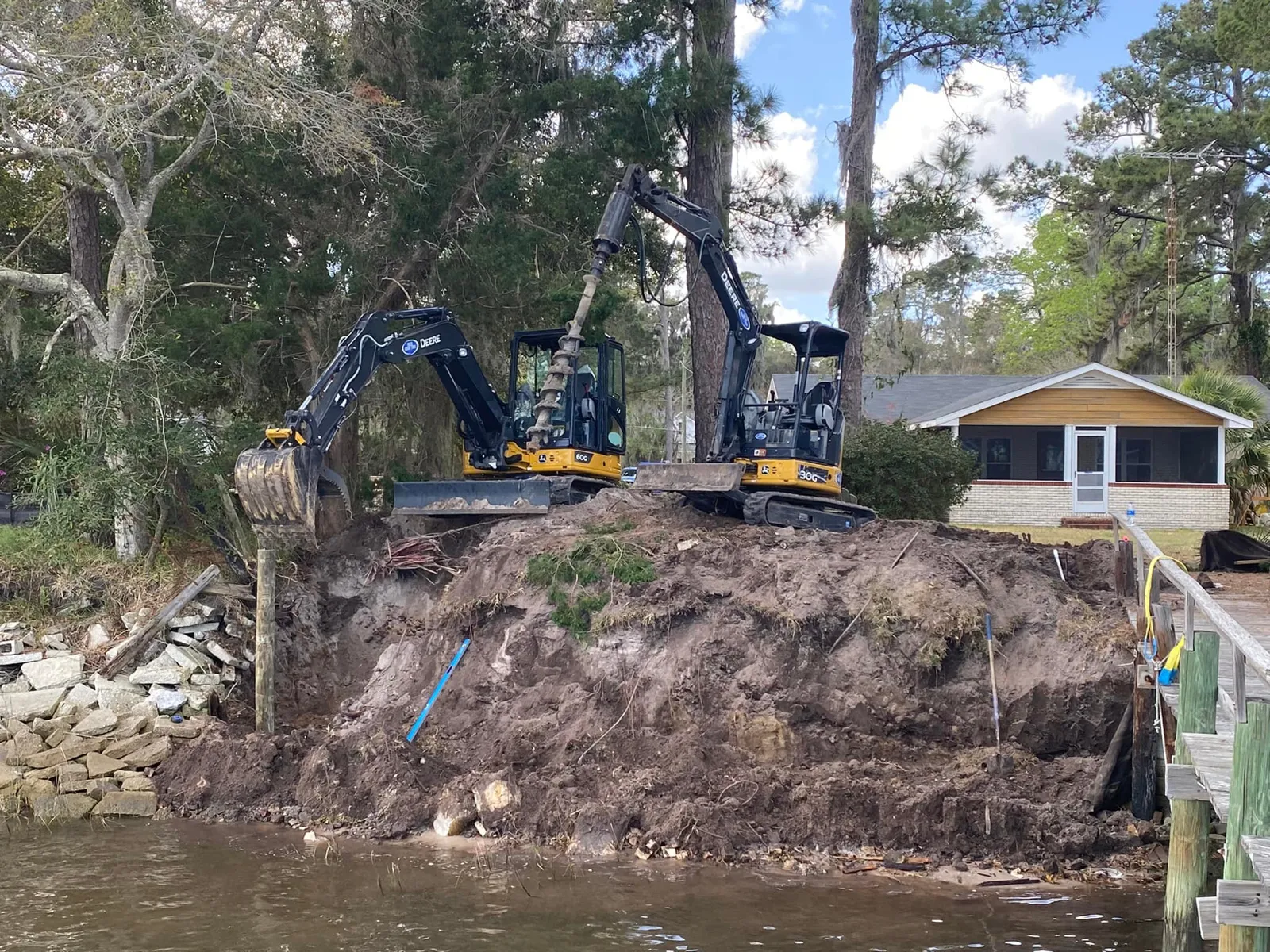
Our crew restoring an eroded bank along the water.
What Does Rock Do for a Canal Wall?
Cape Coral's canals carry heavy boat traffic, and a vertical wall reflects every wake back down to its own base. Over time that scours the toe. Riprap:
Absorbs wake energy before it hits the wall
Protects the toe from scour
Cuts reflected chop in narrow canals
Provides habitat for fish, crabs, and aquatic plants in the crevices
Which Waterfront Lots Benefit Most?
Walls near open water such as the Caloosahatchee and Matlacha Pass, which see larger waves and took direct surge in Ian
Busy through-canals with constant wake
Walls with visible scour or a toe that has started to show
The open-water edges of the city showed how hard surge can hit. During Ian, NHC reported that USGS water-level sensors in both Matlacha and Cape Coral were lost or destroyed, and a sensor at Punta Rassa, across the river mouth at the east end of the Sanibel Causeway, recorded 8.37 feet above normal high tide (NHC Ian report). Walls facing that kind of water benefit most from a rock apron that takes the first hit.
How Is Riprap Installed?
Assess the toe: depth, scour, and wall condition
Lay filter fabric so soil beneath doesn't wash through
Place bedding and armor stone at a stable slope
Shape the ends at property lines
Check against permit conditions
Stone size matters. Rock that's too small gets rolled away by wakes and surge; rock that's too big can leave gaps that let fabric tear. We size the armor layer to the exposure at your lot, which is very different on a quiet dead-end canal than on a wall facing the river. When rock goes in during a seawall replacement, we coordinate it with the City's turbidity-screen requirement so one set of in-water controls covers both jobs.
What About Mangroves and Manatees?
Mangroves often sprout in rock along seawalls. The City's guide says those can be kept trimmed up to 6 feet without a permit, but mangroves taller than 10 feet require one, and removal isn't allowed without a permit. The same guide notes manatees use saltwater canals year-round and are seen most from October to March, so in-water work is planned with protective measures in mind.
How Much Does Riprap Cost in Cape Coral?
In Cape Coral, riprap usually costs $125–$350 per linear foot. A standard 75-foot residential installation comes to about $10,000–$25,000, fully installed and permitted. Stone volume, canal depth, and access set the final price.