Riprap is sloped rock placed at a seawall or bank to absorb wave energy, and in unincorporated Lee County it's required along at least half of every new or replacement seawall on a canal.
✓ Fort Myers Experts✓ Licensed CBC1267322✓ Free Inspections✓ 30 Years Experience
Quick Answer
Seawall Repairs by Solid Foundations provides riprap installation in Fort Myers, FL for canal and riverfront homeowners, HOAs, and commercial owners. Typical projects include county-required rock with replacement walls in Whiskey Creek and Iona, toe protection for scoured Caloosahatchee walls, and rock revetments with mangrove plantings on natural shoreline. Call 866-398-9323 or use the quote form to book a free on-site inspection.
Is Riprap Required for My Fort Myers Seawall?
In unincorporated Lee County, often yes. The county's 2022 code update says riprap must be placed waterward along no less than 50% of the length of any new or replacement seawall on artificial waterbodies, unless it conflicts with state or federal rules or would block boat tie-up areas (Lee County Ord. 22-24).
The same section sets the minimum rock:
Standard
Requirement
Coverage
At least 50% of the new or replacement wall's length
Height
At least 3 ft above the bottom, or up to mean high water
Stone size
Minimum average 12 inches
Exception
Designated watercraft tie-up areas
Inside City of Fort Myers limits, we confirm the city's requirements during permitting; its checklist requires an FDEP authorization letter for all marine work.
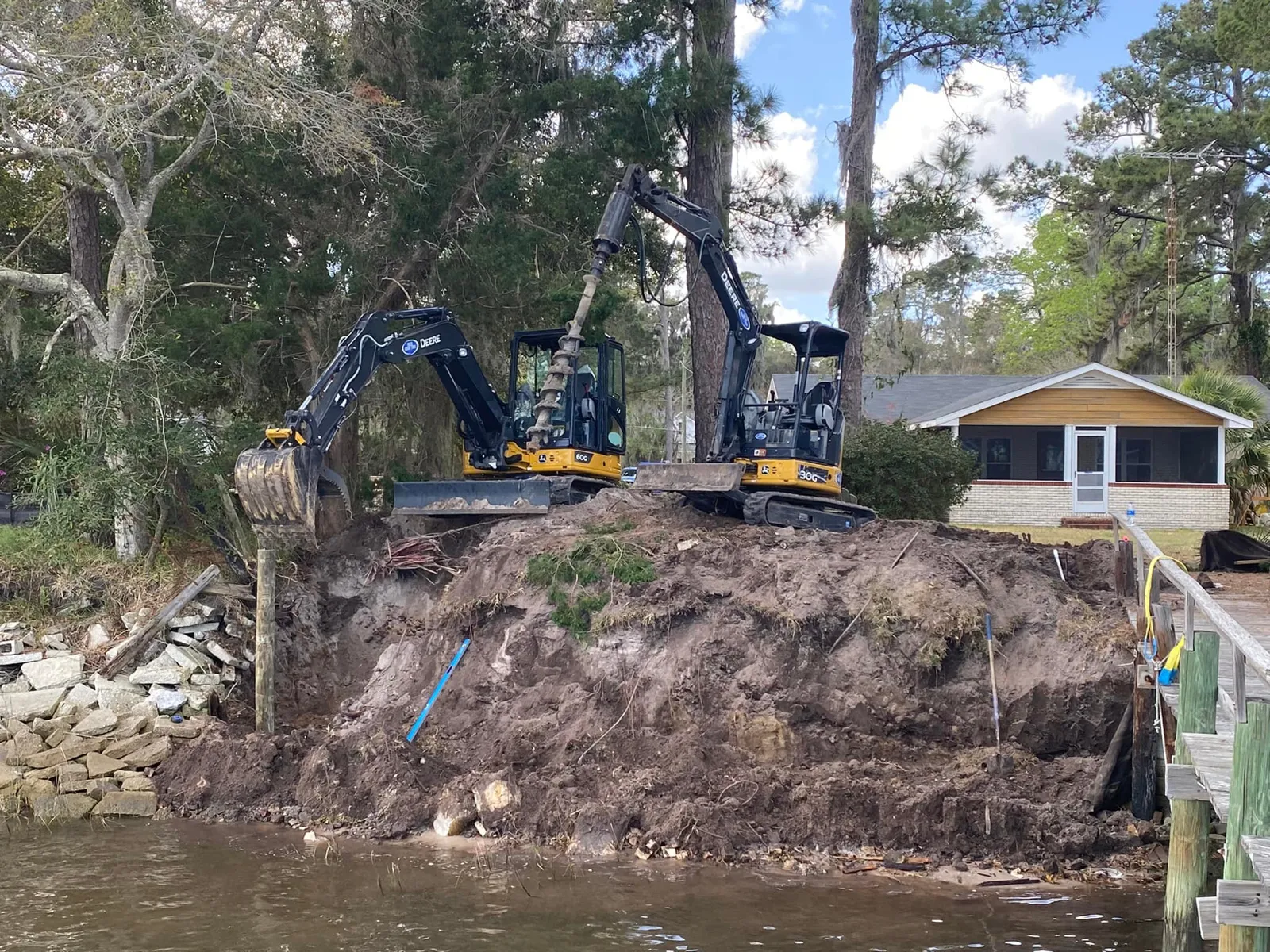
Our crew restoring an eroded bank along the water.
What Does Riprap Do?
A vertical wall reflects wave energy downward, scouring its own base. Riprap:
Absorbs waves and wake before they reach the wall
Protects the toe from scour
Reduces reflection onto neighbors' walls
Adds habitat in the gaps between stones
On the Caloosahatchee, where Ian's surge reversed the river's flow and flooded downtown streets in 2022, a stone apron gives the wall a buffer against both waves and current.
It isn't only the big storms. Charley in 2004 was mostly a wind event here, yet NHC still measured 3.4 and 3.6 feet of surge on Caloosahatchee tide gauges near Fort Myers and 4.2 feet in Estero Bay (NHC Charley report). Moderate surges like that, repeated over the life of a wall, are exactly what scours an unprotected toe.
What About Natural Shoreline?
On natural waterbodies in unincorporated Lee County, new or expanded seawalls aren't allowed, so rock revetments are a common way to protect a bank. The code's revetment rules require stone averaging at least 12 inches on filter fabric, placement that doesn't damage wetland vegetation, and, in many cases, mangroves or approved wetland plants set 3 feet on center within the rock. See revetment maintenance in Fort Myers if you already have one.
How Do We Install Riprap?
Survey the toe: depth, scour, wall condition, vegetation
Lay filter fabric so the soil beneath stays put
Place stone to the required height and coverage
Leave tie-up areas clear where the code allows
Plant where required on natural shoreline
Final check against permit conditions
Stone placement matters as much as stone size. Rock dumped against a wall with no fabric slowly sinks as the soil beneath it washes out, and gaps at the ends let water curl behind the apron. We build the rock as a layered slope, tie it into the neighboring shoreline, and leave your tie-up area open where the code allows. Doing rock and wall together is simplest. See bulkhead replacement in Fort Myers.
How Much Does Riprap Cost in Fort Myers?
In Fort Myers, riprap runs $125–$350 per linear foot. A standard 75-foot residential installation is typically $10,000–$25,000, fully installed and permitted. Stone volume, depth, and access affect the price.