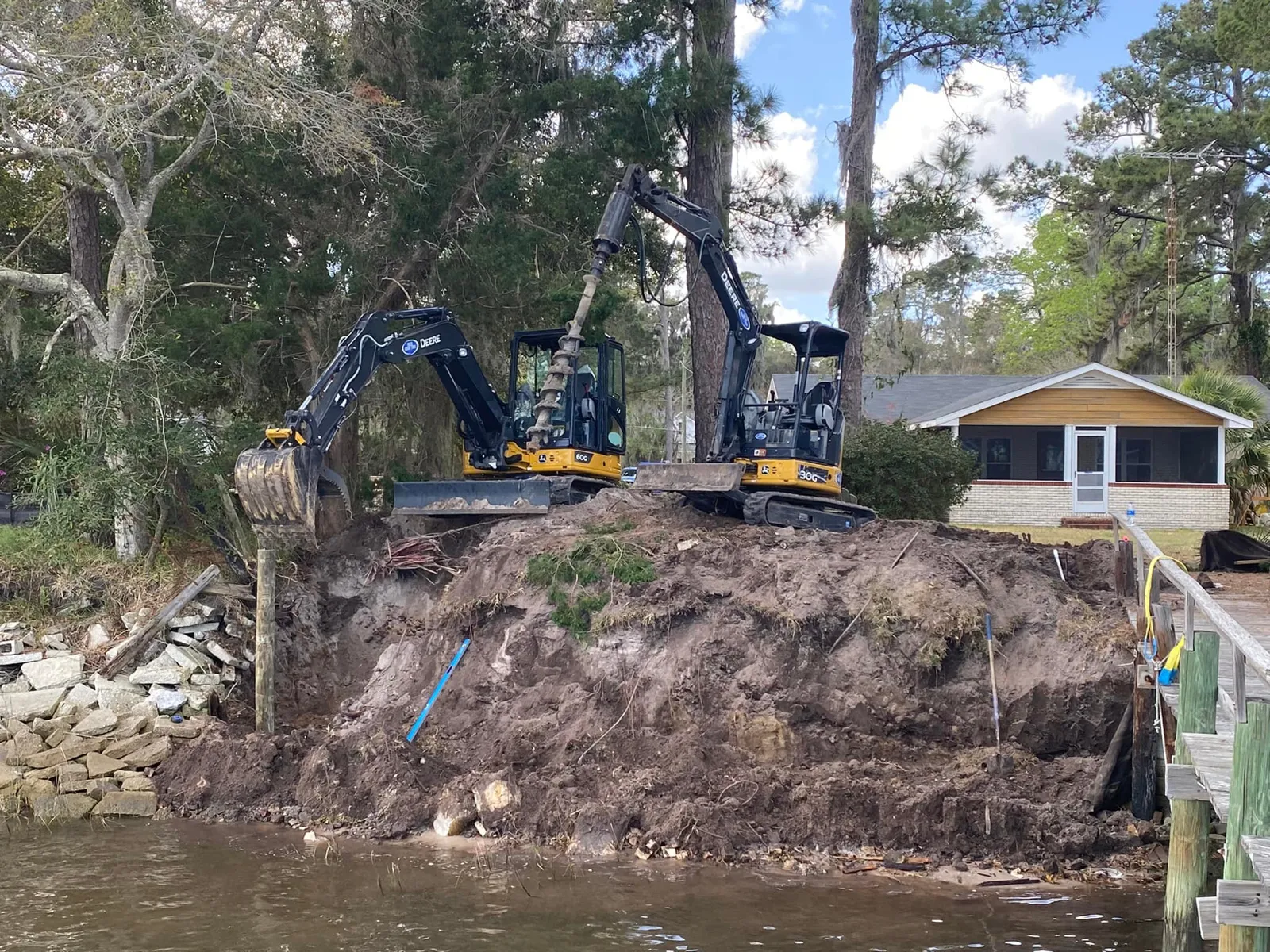
A rock revetment in Miami should be looked over once a year and again after every tropical storm, so loose stones and exposed fabric are fixed before the bank behind them starts to wash away.
✓ Miami Experts✓ Licensed CBC1267322✓ Free Inspections✓ 30 Years Experience
Quick Answer
Seawall Repairs by Solid Foundations provides revetment maintenance in Miami, FL for bayfront homeowners, condo associations, and commercial owners. Typical projects include resetting armor stone on Biscayne Bay slopes after storms, patching torn filter fabric along Miami River banks, and rebuilding scoured toes where revetments meet neighboring Miami seawalls. Call 866-398-9323 or use the quote form to book a free on-site inspection.
What Is a Revetment, and Why Does It Need Upkeep?
A revetment is a rock-armored slope. Large stones sit over smaller rock and a filter fabric, and the whole thing absorbs waves instead of reflecting them. It's durable, but every storm, high tide, and passing wake nudges stones a little. Over years, those small moves open gaps that let the soil underneath escape.
Our crew restoring an eroded bank along the water.
What Warning Signs Should I Watch For?
Stones rolled to the bottom of the slope
Low, flattened spots in an otherwise even bank
Fabric showing between rocks, or torn and loose
Sand washing out at the waterline
Undermining at the toe
Erosion where the rock ends at a neighbor's wall or natural bank
The ends are almost always the first place to fail, because water curls around them. A single missing armor stone can look harmless, but it leaves the smaller rock beneath exposed to every wave. Once that under-layer shifts, the fabric follows, and then the bank itself. Catching it at the one-stone stage is the whole point of maintenance. More background is on our general revetment maintenance page.
When Should a Miami Revetment Be Inspected?
When
Focus
Late spring, before hurricane season
Full walk; reset loose stone; repair fabric
After any tropical storm
Displaced armor, toe scour, washed-out ends
During seasonal high tides
Gaps at the high-water line
Once a year
Slope profile, plant growth, transitions
What Does Revetment Maintenance Involve?
Routine care
Setting displaced stones back into the interlock
Topping up thin areas with matching rock
Removing debris and probing for hollows
Rehabilitation
Toe rebuilds so the slope has a solid footing
Fabric replacement under lifted stone
Re-grading slumped sections to a stable angle
Tying in the ends to neighboring walls
Do mangroves on my revetment change the work?
They can. Miami-Dade requires a Class I permit for most mangrove trimming, alteration, or removal, and applies the same permit to work in tidal waters and coastal wetlands (Miami-Dade County). Mangroves that have rooted among your stones help hold the slope together, so we plan repairs around them rather than clearing them. If trimming is truly needed, we tell you up front so it can be permitted.
Why Are Miami Revetments Under More Pressure Every Year?
Water is simply getting higher. Miami-Dade cites regional projections of 10 to 17 inches of rise by 2040 compared with 2000. Each added inch pushes daily tides farther up the slope, onto stone and fabric that used to stay dry most of the time. The high-water band is where we find most of the washouts now. That's why our inspections look closely at the upper part of the slope, not just the toe.
How Much Does Revetment Maintenance Cost in Miami?
Routine revetment maintenance in Miami typically runs $1,500–$5,000 per year for a standard 100-foot residential revetment. Major rehabilitation runs $150–$400 per linear foot. Steady upkeep costs far less than rebuilding a neglected slope.