Clearwater rock revetments need a yearly inspection plus a check after each tropical storm, so displaced stone, exposed fabric, and scoured toes are repaired before the bank behind them erodes.
✓ Clearwater Experts✓ Licensed CBC1267322✓ Free Inspections✓ 30 Years Experience
Quick Answer
Seawall Repairs by Solid Foundations provides revetment maintenance in Clearwater, FL for harbor-front homeowners, HOAs, condo associations, and commercial properties. Typical projects include resetting armor stone moved by Helene's record surge, rebuilding slumped slopes on Clearwater Harbor frontage, and repairing exposed fabric near Sand Key and Clearwater Beach. Call 866-398-9323 or use the quote form to book a free on-site inspection.
What Is a Revetment, and What Wears It Down?
A revetment is a rock-armored slope used in place of a vertical wall: large armor stone on the surface, smaller stone beneath, and filter fabric against the soil. Waves climb the slope and lose energy. Over time, though, surge and wave action loosen the interlock, and once stones shift, gaps open where soil can escape.
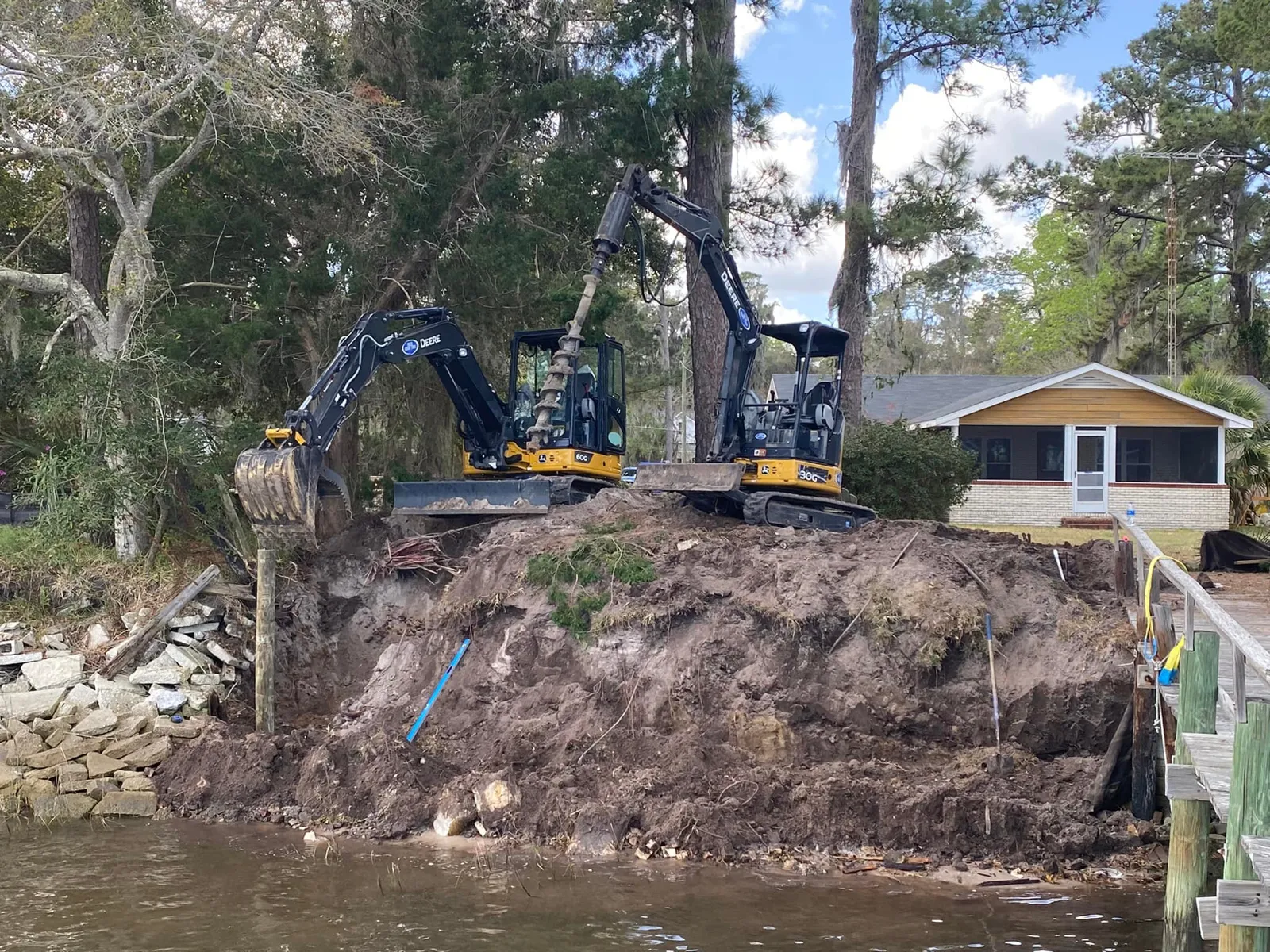
Our crew restoring an eroded bank along the water.
What Should You Look For?
Stones missing from the face or collected at the toe
Slumped or flattened stretches
Fabric exposed or torn
Sand or soil running out between stones
An undercut bottom row
Erosion at the ends where rock meets a neighbor's wall
Ends are the usual first failure point, because water wraps around them.
How Often Should a Clearwater Revetment Be Inspected?
When
What we look at
Spring, before hurricane season
Full walk; reset stones; repair fabric
After any named storm
Moved armor, toe scour, end washouts
After long stretches of onshore wind
Stone disturbed on harbor-facing slopes
Once a year
Slope profile, vegetation, transitions
Helene is why the post-storm row matters here. NHC measured about 6.75 feet above normal high tide at Clearwater Beach in 2024 (NHC Helene report). Water at that height reaches the top of most rock slopes, and it tugs on stones that sit above the reach of ordinary tides.
What's Involved in Revetment Maintenance?
Routine work
Resetting displaced armor stone
Adding stone where the slope has thinned
Clearing debris lodged between rocks
Rehabilitation
Toe reconstruction so the slope has a stable base
Fabric replacement beneath lifted stone
Re-grading slumped areas
Transition repair tying the ends into adjacent walls
Why Does Timing of a Storm's Peak Matter?
Surge doesn't always arrive at high tide. NHC noted that during Idalia in 2023, the Clearwater gauge peaked at about 3.9 feet above normal high tide, but that peak didn't line up with the high tide (NHC Idalia report). Had it, the water would have been higher. Clearwater Beach's normal daily range is under three feet, so the tide's timing can swing a storm's effect on your slope significantly. That's why we inspect after every named storm, not just the ones that made headlines. A slope can look tidy from the lawn while its bottom row has been undercut below the waterline, so we probe the toe at low tide rather than relying on what's visible from above. That's also where most of the cost savings come from: a toe caught early takes a few tons of stone, while one left alone can take the whole slope with it.
How Much Does Revetment Maintenance Cost in Clearwater?
Revetment maintenance in Clearwater typically costs $1,500–$5,000 per year for a standard 100-foot residential revetment. Major rehabilitation runs $150–$400 per linear foot. Keeping up with it costs far less than rebuilding a neglected slope.
Helene moved stones on my harbor-front revetment. What should be fixed first?
Any exposed fabric or soil, since that's where erosion starts. Resetting surface stone comes next.
Does resetting rock in Clearwater Harbor need approval?
Pinellas County permits riprap and shoreline work, and the harbor is in an aquatic preserve. Maintenance in the existing footprint is often simpler, but we confirm first.
The corner where my rock meets the next wall keeps eroding. Why?
Water concentrates at transitions. A proper tie-in fixes it; more loose rock usually doesn't.
How long can a maintained revetment last?
Decades, as long as the toe stays armored and the fabric stays covered.