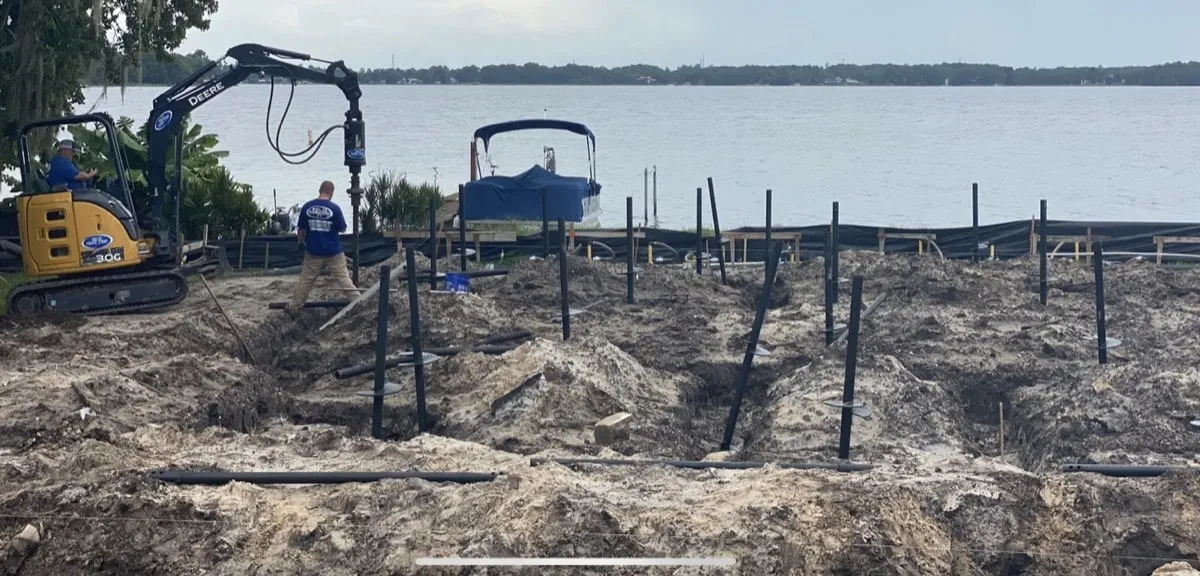
When a dock, deck, or lift near the water in Beaufort starts to sag, the lasting repair is to carry its weight through soft marsh soil to firm ground with helical piers, or to fill voids beneath slabs with polyurethane.
✓ Beaufort Experts✓ Licensed in GA & SC✓ Free Inspections✓ 30 Years Experience
Quick Answer
Seawall Repairs by Solid Foundations provides marine foundation repair in Beaufort, SC for waterfront homeowners, associations, and marinas. Typical projects include helical piers under sinking dock walkways on Lady's Island, re-leveling boat lifts on Beaufort River lots, and lifting settled patios behind older bulkheads. Call 866-398-9323 or use the quote form to book a free on-site inspection.
What Signs Point to Settlement?
The walkway sags where it leaves the yard.
A lift tilts, or its pilings lean.
Pavers sink along the bulkhead.
Cracks run parallel to the water in a patio or pool deck.
Doors stick in a dock house or porch near the marsh.
The cap pulls away from the deck.
The cause is usually soft soil that can't carry the weight or soil washing out through the wall.
Piling work next to the water.
Why Does Ground Settle Around Beaufort's Waterfront?
Pluff mud. South Carolina has about 344,500 acres of salt marsh, the most of any East Coast state (SCDNR). Beneath much of it lies pluff mud, a thick, spongy, oxygen-poor soil that compresses under weight. Where a lot slopes from upland into marsh, the ground under a dock landing or deck post can change from firm sand to soft mud in just a few feet.
Old working waterfront. Beaufort's riverfront has carried docks and wharves for a very long time. The site of today's Henry C. Chambers Waterfront Park was once the city's docks and wharves, and much of the park is still a pier set on pylons over the Beaufort River (National Park Service). Older waterfront ground often holds layers of fill and buried timber that settle unevenly.
Either way, patching the surface doesn't last. The load has to be carried past the weak layer to ground that won't keep moving.
Which Repairs Work Best on Beaufort's Soft Ground?
Screw-in steel piers
A helical pier looks like a giant steel screw. We wind it down through the mud with a hydraulic head, watching the resistance climb until it bites into ground strong enough to carry your dock, lift, or deck. Once it's there, a bracket ties the pier to the structure, and we jack the sagging section back up toward level. No concrete has to cure, so the structure can go back into use quickly. More on helical pier installation.
Foam under slabs
Patios and pool decks that have dropped because soil washed away beneath them can often be raised with polyurethane injection. The foam fills the hollow, firms the ground, and lifts the slab without breaking it up.
Rebuilding tired pilings
When a dock or lift piling has rotted at the mudline or been hollowed by borers, we can jacket it, add a sister piling alongside, or set new support next to it.
Closing the leak first
Settling next to a leaking bulkhead won't stop until the soil stops escaping. In that case, we start with bulkhead repair in Beaufort and then level what's above it.
How Much Does Marine Foundation Repair Cost in Beaufort?
Typical Beaufort pricing is $700–$2,000 per helical pier and $8–$25 per board foot for void fill. Most residential marine foundation repairs run $5,000–$25,000, depending on pier count, depth to firm soil, and access.
What If a Storm Takes Out My Dock?
Matthew showed how much damage one storm can do here. Beaufort County removed 33 vessels and about 16,700 cubic yards of debris from roughly 107,000 acres of waterway, including broken and sunken docks (Beaufort County Disaster Recovery). Under SC Regulation 30-12, a destroyed dock may generally be rebuilt to its previous configuration if the work is finished within five years of the event. For a rebuild or new layout, see marine construction in Beaufort. Our Beaufort seawall repair page lists our other services.