A rock revetment on Lake Worth Lagoon should be inspected every year and after every major storm, so shifted stones and exposed fabric are fixed before the bank behind them erodes.
✓ West Palm Beach Experts✓ Licensed CBC1267322✓ Free Inspections✓ 30 Years Experience
Quick Answer
Seawall Repairs by Solid Foundations provides revetment maintenance in West Palm Beach, FL for lagoon-front homeowners, condo associations, and commercial owners. Typical projects include resetting armor stone on exposed lagoon slopes after storms, repairing torn fabric at the king-tide line, and rebuilding toes where revetments meet neighboring West Palm Beach seawalls. Call 866-398-9323 or use the quote form to book a free on-site inspection.
What Is a Revetment, and Why Does It Need Care?
A revetment is a sloped, rock-armored bank: big stones over smaller rock and filter fabric. It absorbs wave energy rather than bouncing it back like a vertical wall. It's tough, but storms, wake, and seasonal high water all shift stones a little. Left alone, those small moves open paths for the soil underneath to escape.
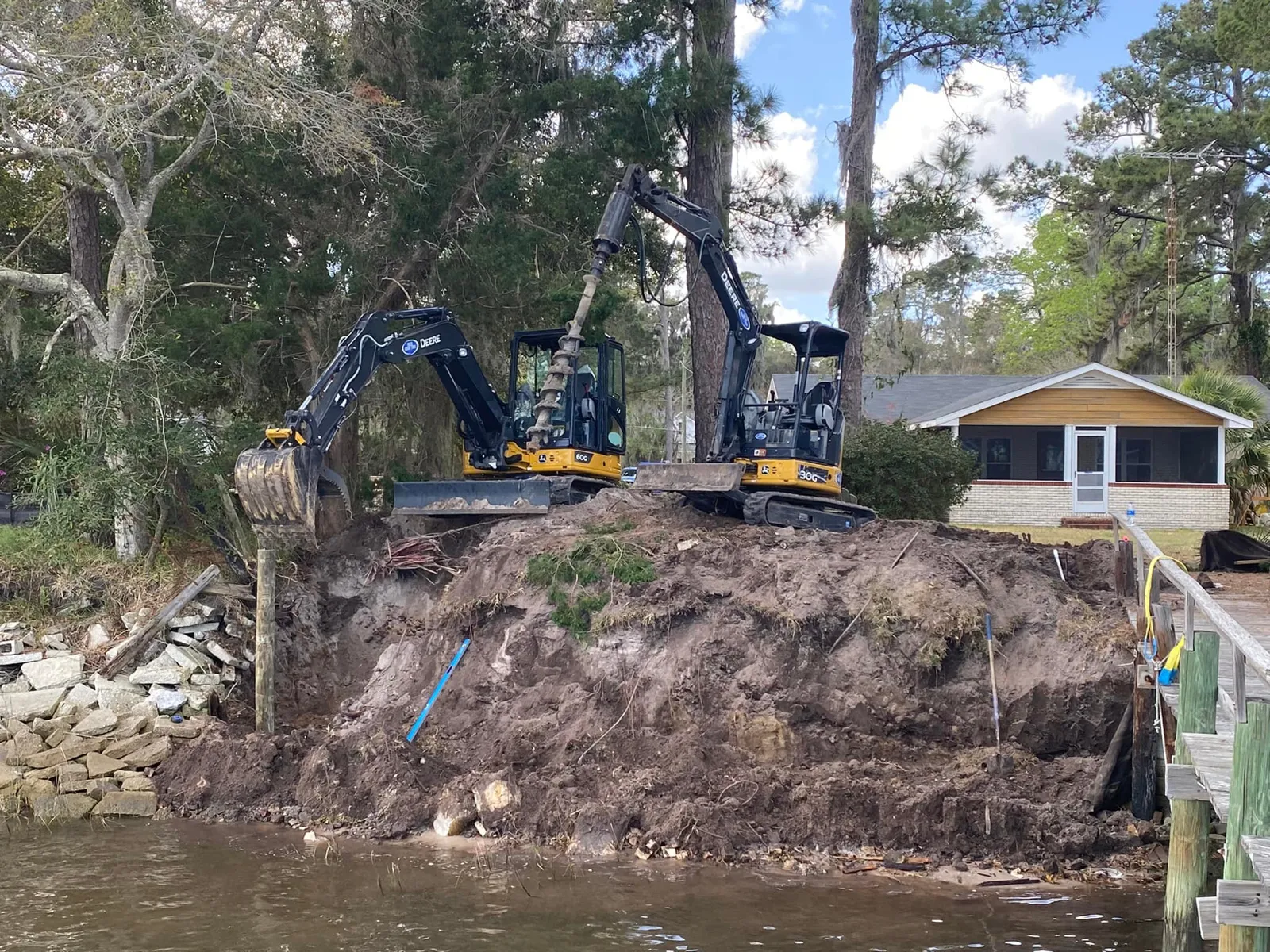
Our crew restoring an eroded bank along the water.
Which Signs Mean My Revetment Needs Work?
Stones missing or piled at the base
Slumped areas where the slope has flattened
Fabric exposed or torn
Soil washing out between rocks
Undermining at the toe
Erosion at the ends, where rock meets a wall or natural bank
The ends go first, because water wraps around them. One missing armor stone may not look like much, but it exposes the smaller rock underneath to every wave, and once that layer moves the fabric and soil follow.
When Should I Inspect a West Palm Beach Revetment?
When
What to check
Spring, before June
Full walk; loose stone; fabric condition
After any named storm
Displaced armor, scour, end washouts
After fall king tides
Washouts along the high-water band
Once a year
Slope profile, vegetation, transitions
What Does Maintenance Involve?
Routine care
Resetting displaced armor stone
Topping up thin areas with matching rock
Clearing debris and checking for hollows
Rehabilitation
Toe rebuilds so the slope has a stable footing
Fabric replacement under lifted stone
Re-grading slumped sections
Transition repairs where rock meets a neighbor's wall
Mangroves that take root among the stones help hold the slope together. We work around them.
How Much Storm Energy Reaches the Lagoon?
Less than the beach, usually, but not none. During Hurricane Irma in 2017, the National Weather Service recorded 1 to 2 feet of inundation at the beachfront from Fort Lauderdale north through the Palm Beaches (NWS Miami). Inside the lagoon, the larger threat is often wind-driven waves across open water, plus the extra water that comes in through the two inlets and down the flood-control canals. A few inches of added water depth lets waves reach stones higher on the slope. That's why we check the upper band as closely as the toe.
Why does revetment care matter for the lagoon?
Rock shorelines are part of how the lagoon is recovering. Palm Beach County's restoration work includes projects like Snook Islands, which created about 11 acres of mangroves and 60 acres of seagrass (Palm Beach County ERM). A well-kept revetment gives oysters and fish surfaces to use and keeps sediment out of nearby seagrass. A neglected one sheds soil into the water every time it rains.
How Much Does Revetment Maintenance Cost in West Palm Beach?
Routine revetment maintenance in West Palm Beach typically runs $1,500–$5,000 per year for a standard 100-foot residential revetment. Major rehabilitation runs $150–$400 per linear foot. Regular upkeep costs far less than rebuilding a neglected slope.
How often should my lagoon revetment be inspected?
At least once a year, ideally before hurricane season, plus after any named storm.
Do I need a permit to reset stones in West Palm Beach?
Routine work within the existing footprint is typically simpler than expanding. Changes to the slope or footprint usually need permits. We confirm first.
Can mangroves stay when you repair my revetment in West Palm Beach?
Usually, yes. They help stabilize the slope, and we work around them.
Why does the high-tide line wash out first?
Seasonal high water and waves concentrate there. It's where fabric gets exposed most often.