A leaning Fort Lauderdale seawall with sound panels can usually be held in place with helical tiebacks, which cost far less than a new wall and take days instead of weeks.
✓ Fort Lauderdale Experts✓ Licensed CBC1267322✓ Free Inspections✓ 30 Years Experience
Quick Answer
Seawall Repairs by Solid Foundations provides seawall reinforcement in Fort Lauderdale, FL for canal-front homeowners, HOAs, and commercial properties. Typical projects include helical tiebacks on bowing Rio Vista and Harbor Beach canal walls, replacing rusted tie rods on older Coral Ridge walls, and pairing anchors with drains where heavy rain loads the backfill. Call 866-398-9323 or use the quote form to book a free on-site inspection.
Is My Wall a Candidate for Reinforcement?
It is if the concrete is still in good shape but the wall is moving:
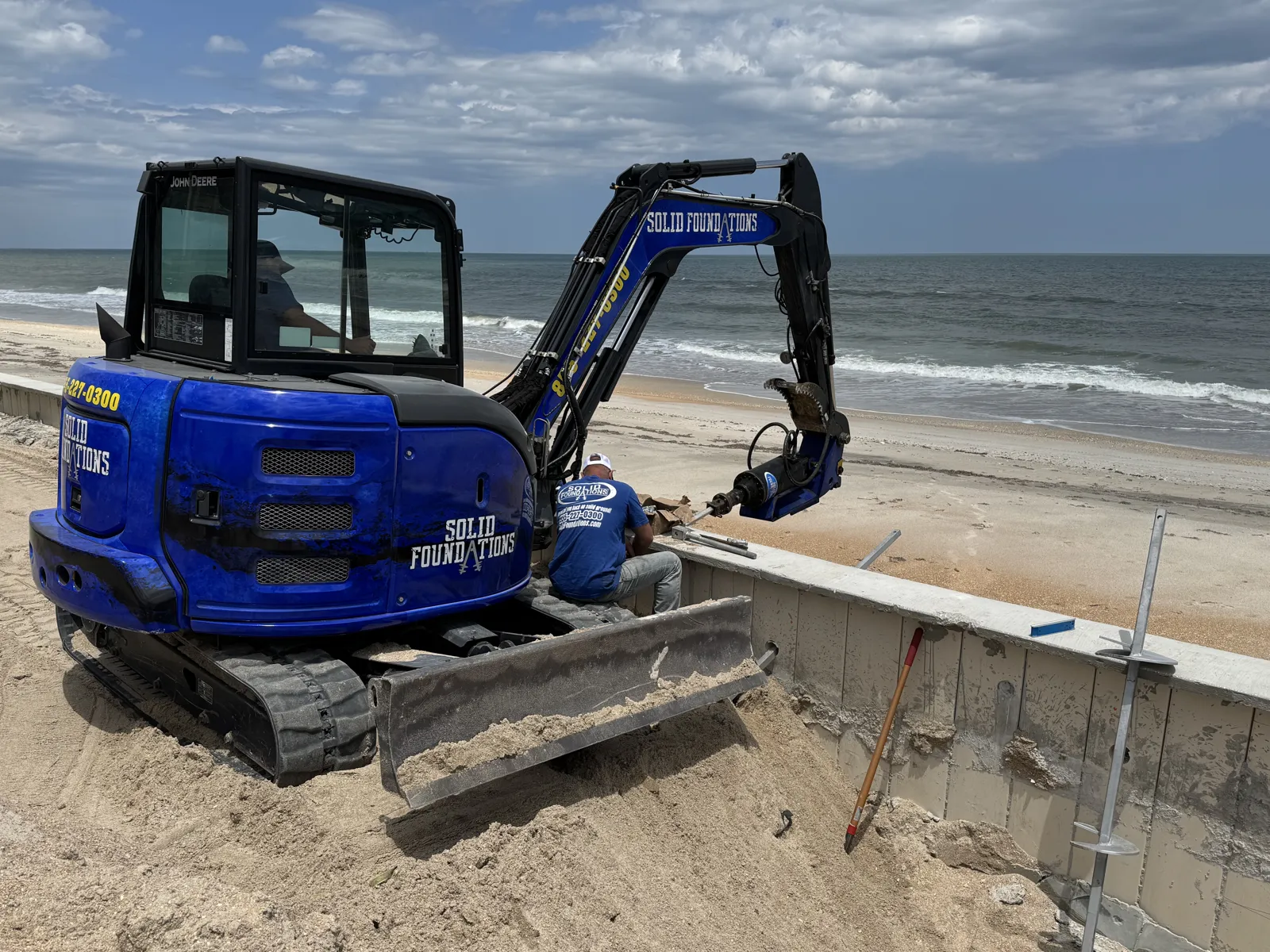
Helical tiebacks going in on a beachfront seawall.
What Pushes Fort Lauderdale Seawalls Out of Line?
Record rain
On April 12, 2023, the National Weather Service measured 25.91 inches of rain at the Fort Lauderdale airport, the most ever recorded there in a single day (2023 Fort Lauderdale floods). NWS analysis put parts of the area beyond a 1-in-1,000 annual chance for that rainfall (NWS). Soil behind a seawall can't shed that much water quickly. Saturated fill is heavy, and it leans hard on the wall until it drains.
Tides that keep climbing
Fall king tides now flood streets on islands like Hendricks Isle. Each high tide soaks the backfill, and each ebb pulls a little sand toward any gap.
Worn-out anchors
Many original walls rely on steel tie rods to buried blocks. After decades in brackish and salt water, those rods thin out and the wall starts to rotate.
Which Reinforcement Methods Do We Use?
Helical tiebacks
Steel anchors with helix plates are drilled through the wall at an angle into firm soil and locked off at the face. Each one works as a new tie rod. Most homes take one or two days. More detail: helical tiebacks.
Deadman anchors
On lots with room behind the wall, a buried concrete block tied to the wall holds it back.
Walers
A beam along the wall face spreads loads across panels on longer runs.
How Do Reinforcement and Replacement Compare on Cost?
Reinforcement
Replacement
Typical 80-ft residential wall
$12,000–$35,000
$40,000–$80,000
Time on site
Usually 1–3 days
Usually 1–3 weeks
Yard disruption
Light
Heavy
Height standard
Usually unaffected by partial work
New wall must meet the 5-ft standard
Does Reinforcing a Wall Count as a Substantial Repair?
That's a fair question in Fort Lauderdale, since work on more than half of a wall's length can trigger the 5-foot height rule. Anchoring a short leaning section usually doesn't. A project that touches most of the wall might. We review the scope with you and the city before work starts, so there are no surprises once the anchors are in. If your wall is both leaning and too low, it can make sense to price reinforcement and replacement side by side. Sometimes anchoring buys a decade of use at a fraction of the cost; other times the height rule tips the math toward a new wall. We'll show you both numbers so you can decide.